
|
Pseudorhombus triocellatus (Bloch & Schneider, 1801) Three spotted flounders |
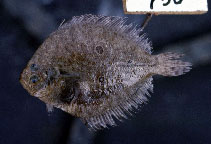
|
|
photo by
CSIRO |
| Family: | Paralichthyidae (Large-tooth flounders) | |||
| Max. size: | 15 cm SL (male/unsexed) | |||
| Environment: | demersal; marine; depth range - 17 m | |||
| Distribution: | Indo-West Pacific: India and Sri Lanka to western Thailand, Sumatra and the southern islands of Indonesia, and northwestern Australia. | |||
| Diagnosis: | Dorsal spines (total): 0-0; Dorsal soft rays (total): 65-70; Anal spines: 0-0; Anal soft rays: 49-52. Body brownish, with 1 ocellus above and below lateral line and 1 ocellus on posterior third of straight section of lateral line. Many indistinct spots and blotches on body. Pectoral fin on ocular side with 11-12 soft rays (Ref 9774). | |||
| Biology: | Found on the muddy and sandy bottoms of the continental shelf. Feeds on benthic organisms. Sold fresh and dried salted in markets. | |||
| IUCN Red List Status: | Least Concern (LC); Date assessed: 08 March 2021 Ref. (130435) | |||
| Threat to humans: | harmless | |||