| Family: |
Phycidae (Phycid hakes) |
| Max. size: |
42 cm NG (male/unsexed) |
| Environment: |
benthopelagic; marine; depth range 90 - 1500 m, non-migratory |
| Distribution: |
Western Atlantic: Canada to straits of Florida, found in the outer continental shelves and slopes, but not abundant to south of Cape Hatteras. |
| Diagnosis: |
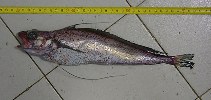
Dorsal spines (total): 0-0; Anal spines: 0-0. Dorsal fin with an extremely elongated ray, its length longer than head length. Longest pelvic-fin ray reaching beyond the posterior end of the anal-fin base. Olive on sides, belly pale; the margins of the dorsal, caudal and anal fins darker. |
| Biology: |
Epibenthic (Ref. 58426). Minimum depth at 90 m (Ref. 1371). Most abundant between 360 and 800 m. Feeds mostly on crustaceans (especially euphausiids, shrimps and amphipods (Ref. 5951)) but also on mollusks and fishes (Ref. 1371). |
| IUCN Red List Status: |
Not Evaluated (N.E.) Ref. (130435)
|
| Threat to humans: |
harmless |
Source and more info: www.fishbase.org. For personal, classroom, and other internal use only. Not for publication.