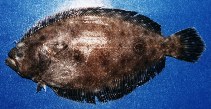
| Family: |
Paralichthyidae (Large-tooth flounders) |
| Max. size: |
48 cm TL (male/unsexed); 62 cm TL (female) |
| Environment: |
demersal; marine; depth range 6 - 200 m |
| Distribution: |
Southeast Pacific: Chile (Ref. 9068). Southwest Atlantic: Rio de Janeiro, Brazil to Patagonia, Argentina (Ref. 36453). |
| Diagnosis: |
Dorsal spines (total): 0-0; Dorsal soft rays (total): 78-84; Anal spines: 0-0; Anal soft rays: 60-65; Vertebrae: 37-39. Scales ctenoid only on the ocular side, cycloid on the blind side (Ref. 43588). |
| Biology: |
Ranges from the coast to 200 m depth (Ref. 36453). Frequently captured over sandy bottoms (Ref. 42588). Feeds mainly on fishes, also shrimps (Ref. 36453). |
| IUCN Red List Status: |
Vulnerable (VU); Date assessed: 06 December 2019 (A2bcd) Ref. (130435)
|
| Threat to humans: |
harmless |
Source and more info: www.fishbase.org. For personal, classroom, and other internal use only. Not for publication.