
|
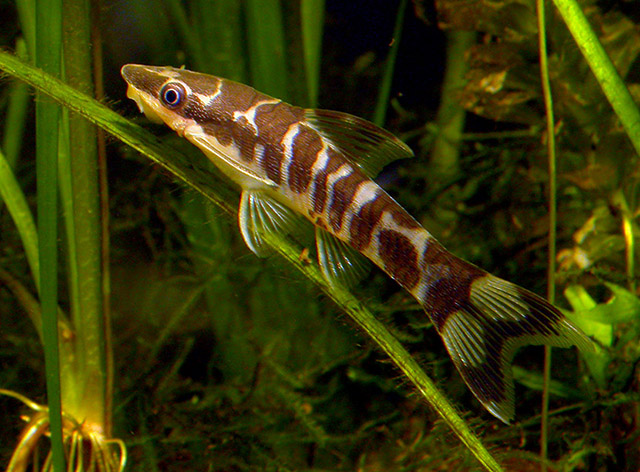
Otocinclus cocama Reis, 2004 |
|
|
photo by
Noren, M. |
| Family: | Loricariidae (Armored catfishes), subfamily: Hypoptopomatinae | |||
| Max. size: | 4.38 cm SL (male/unsexed) | |||
| Environment: | demersal; freshwater | |||
| Distribution: | South America: Peru. | |||
| Diagnosis: | Dorsal spines (total): 2-2; Dorsal soft rays (total): 7-7; Anal spines: 1-1; Anal soft rays: 5-5; Vertebrae: 28-28. Can be distinguished from all its congeners by the following putative autapomorphies: unique, distinct color pattern consisting of vertically elongated blotches spanning from the dorsal midline to the ventral border of flanks; complete lateral line, without the gap plates (midbody plates without lateral line perforations) present in other Otocinclus. Can also be differentiated by having high number of teeth (30-45 in premaxilla and 23-36 in dentary). Differs from Otocinclus huaorani, Otocinclus mura and Otocinclus bororo by having a small metapterygoid channel and one W-shaped mark in the caudal fin (Ref. 57860). | |||
| Biology: | Found in a medium size creek with clear water and lost of marginal vegetation (Ref. 57860). | |||
| IUCN Red List Status: | Endangered (EN); Date assessed: 24 April 2014 (B1ab(v)) Ref. (130435) | |||
| Threat to humans: | harmless | |||