
|
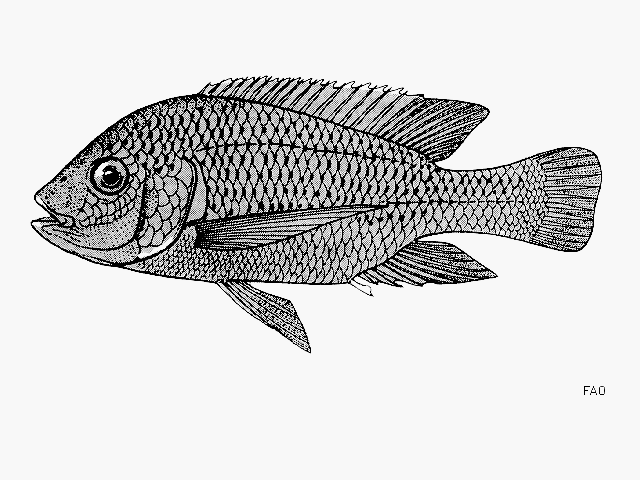
Oreochromis saka (Lowe, 1953) |
|
|
photo by
FAO |
| Family: | Cichlidae (Cichlids), subfamily: Pseudocrenilabrinae | |||
| Max. size: | 36 cm SL (male/unsexed) | |||
| Environment: | benthopelagic; freshwater | |||
| Distribution: | Africa: Endemic to Lake Malawi. | |||
| Diagnosis: | Dorsal spines (total): 15-17; Dorsal soft rays (total): 10-11; Anal spines: 3-3; Anal soft rays: 8-10; Vertebrae: 30-32. Breeding males black, in some with white or yellowish dorsal lappets. Testes broad, white and sinuous when fully ripe. Lower pharyngeal toothed area with concave sides; median length of bone 1.2-1.3 times its width and 35.5-39.2 % length of head; blade 1.3-2.1 times median length of toothed area. Caudal fin scaly. | |||
| Biology: | Occurs at a temperature range of 21.5-29.0 °C (Ref. 2). Inhabits very shallow and vegetated regions. Feeds on diatoms and debris collected from the bottom and from between vegetation (Ref. 5595). | |||
| IUCN Red List Status: | Not Evaluated (N.E.) Ref. (130435) | |||
| Threat to humans: | harmless | |||