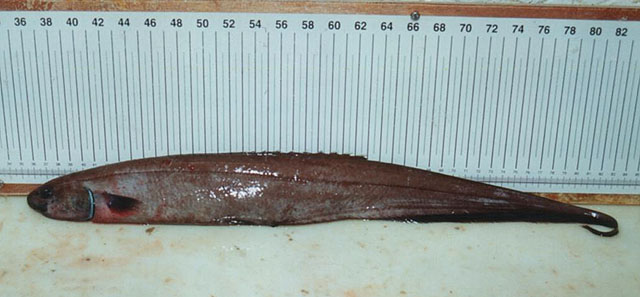
| Notacanthidae (Deep-sea spiny eels) |
| 120 cm TL (male/unsexed) |
|
benthopelagic; marine; depth range 125 - 3285 m |
| Western North Atlantic: from Labrador to the Gulf of Mexico; Eastern North Atlantic from Iceland and Norway to North Africa (Ref. 130977). Possible in the eastern Indian Ocean: Australia (Ref. 7300) and southwest Pacific: New Zealand (Ref. 5755). |
|
Dorsal spines (total): 5-12; Dorsal soft rays (total): 2-2; Anal spines: 14-17; Anal soft rays: 125-145; Vertebrae: 225-239. Presence of palatine and dentary teeth in two or more rows. Numerous dorsal spines. Small specimens are pale tan or pale bluish gray, large specimens are dark brown (Ref. 37108). |
| Benthopelagic (Ref. 58302) and epibenthic (Ref. 58426). Not uncommon in depths around 180 m off Iceland and Greenland. Individuals with nearly ripe eggs have been found in late autumn off Iceland. Mostly found at depths well below 200 m, but enters slightly shallower water on Grand Banks in Canada (Ref. 7251). Feeds primarily on sea anemones (Ref. 4449). |
|
Least Concern (LC); Date assessed: 14 March 2011 Ref. (130435)
|
| harmless |
Source and more info: www.fishbase.org. For personal, classroom, and other internal use only. Not for publication.