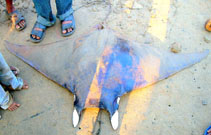
| Family: |
Mobulidae (Devilrays) |
| Max. size: |
123 cm WD (male/unsexed); 130 cm WD (female) |
| Environment: |
pelagic-oceanic; marine; depth range 0 - 50 m |
| Distribution: |
Indo-West Pacific: tropical-subtropical; from the northern Red Sea (26ºN; Egypt) to South Africa (29ºS; Durban); eastward into the Arabian–Persian Gulf, Arabian Sea, Pakistan, southern India, Bangladesh, Malaysia, West and North Australia, to western Pacific, including Sarawak and parts of Indonesia, north to Taiwan (22ºN; Kaohsiung), western Papua New Guinea, and eastern Australia (26ºS; New South Wales). |
| Diagnosis: |
This small mobulid is distinguished by the following characters: pectoral fins very short and with one of the lowest aspect ratios of the genus (i.e. the ratio of DW to disc length, 1:0.578, n = 50), with high relative values of longitudinal metrics (e.g. disc length and anterior projection); head and cephalic fins very elongated with tip of cephalic fin to spiracle 16.5% of DW (n = 50); pre-oral length 5.9% of DW (n = 50); no caudal spine; base of tail quadrangular in section; spiracle very small, subcircular, ventral to plane of pectoral fins; a distinct dark blotch on ventral side of pectoral fins at the midpoint along the leading edge; branchial filter plates distinctively reduced, with four (rarely five) lateral lobes; terminal lobe also distinctively elongated and leaf shaped, pointed terminal lobe (its length almost one-quarter of the plate); colour of plates whitish pink; tooth bands on average 73% of mouth width; most teeth in adult males with multiple long lingual cusps (Ref. 132274).
Description: Branchial filter plates are quite distinctive and differ from all other Mobula species for having the following features: (i) of a whitish pink colour; (ii) much reduced, with only four (rarely five) ascending lobes per plate; and (iii) with a very elongated, pointed terminal lobe (its length almost one-quarter of the plate). Differs from plates of M. kuhlii which are very similar to those of other pygmy devil rays, having a much darker coloration, higher number of lateral lobes (17-18), and a rounded spade-shaped terminal lobe and such morphological differences in gill plates are likely to reflect dietary differences between the two species, with M. eregoodoo specializing in chasing schooling baitfish, which do not require fine-meshed plates to filter them in the mouth, at the same time reducing drag when swimming with an open mouth; unlike M. kuhlii, which is reported to feed on swarms of mysid shrimps or larval fish fry, therefore requiring a much finer mesh in their filter plates.
Teeth morphology also has diagnostic value where unlike in M. kuhlii, the enamel of the labial face (particularly visible on non-functional teeth along the lingual side of the tooth band) is well ornamented in M. eregoodoo, with enamel ‘blisters’ that tend to fuse on the rounded visor. Furthermore, compared with the closely related M. kuhlii, which shares similar crown outline variation in juvenile specimens, the teeth of adult M. eregoodoo have a crown with a more ornamented labial face and a more irregular outline, with several lingual cusps, whereas the M. kuhlii male tooth crown usually has only a pair of nearly symmetric cusps. Tooth morphology of M. eregoodoo, particularly in males, can be considered as intermediate between M. thurstoni (irregularly elongated teeth with strongly ornamented enamel) and M. kuhlii (regularly short teeth with less ornamented enamel), and is clearly distinct from both.
Colouration of M. eregoodoo is specific and facilitates distinction from any other mobulid (M. kuhlii included), particularly on its ventral side, with a striking dark blotch along the midpoint of the leading edge of the pectoral fins being most prominent; remainder of the ventral side usually white (vs. ventral side of M. kuhlii, where the dark blotch is absent and where pectoral fins show a shading of grey in their distal third, gradually becoming darker towards the tips); leading edge of the pectoral fin is dark and stands out against the white background of the ventral surface (vs. anterior margin of the pectoral fins is edged by a distinctive light-coloured stripe, a few centimetres wide, which runs almost the entire length of the margin in M. kuhlii) (Ref. 132274). |
| Biology: |
Found in coastal and oceanic waters (Ref. 30573); solitary or aggregations, sometimes with 50 or more individuals (Ref. 90102). Not known to penetrate the epipelagic zone (Ref. 9911). Ovoviviparous (Ref. 50449). |
| IUCN Red List Status: |
Endangered (EN); Date assessed: 20 January 2020 (A2bd+3d) Ref. (130435)
|
| Threat to humans: |
harmless |
Source and more info: www.fishbase.org. For personal, classroom, and other internal use only. Not for publication.