
|
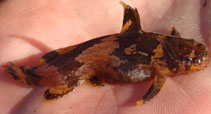
Microglanis cottoides (Boulenger, 1891) |
|
|
photo by
Correa, E. |
| Family: | Pseudopimelodidae (Bumblebee catfishes, dwarf marbled catfishes), subfamily: Batrochoglaninae | |||
| Max. size: | 6.75 cm SL (male/unsexed) | |||
| Environment: | demersal; freshwater | |||
| Distribution: | South America: Laguna dos Patos and rio Uruguay drainages in Brazil. | |||
| Diagnosis: | Dorsal spines (total): 1-1; Dorsal soft rays (total): 6-6; Anal soft rays: 9-12; Vertebrae: 30-30. Distinguished from M. parahybae and M. cibelae by the longer head (29.3-33.8% SL, versus 23.2-27.6 and 25.6-31.1 respectively) and wide body (28.5-33.9% SL versus 23.8-27.7 and 25.4-29.8, respectively). The smaller mouth width distinguish this species from M. eurystoma (50.6-64.3% HL, versus 67.3-84.4). | |||
| Biology: | Reported to reach approximately 9 cm SL (Ref. 81048). | |||
| IUCN Red List Status: | Least Concern (LC); Date assessed: 16 November 2020 Ref. (130435) | |||
| Threat to humans: | harmless | |||