
|
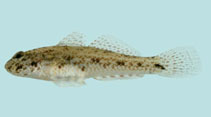
Macrodontogobius wilburi Herre, 1936 Largetooth goby |
|
|
photo by
Winterbottom, R. |
| Family: | Gobiidae (Gobies), subfamily: Gobiinae | |||
| Max. size: | 6.5 cm SL (male/unsexed) | |||
| Environment: | reef-associated; brackish; marine; depth range 0 - 20 m | |||
| Distribution: | Indo-Pacific: Seychelles eastward into Oceania, including Micronesia, Fanning, and Phoenix islands. | |||
| Diagnosis: | Dorsal spines (total): 7-7; Dorsal soft rays (total): 9-11; Anal spines: 1-1; Anal soft rays: 9-10; Vertebrae: 26-26. Ground color of dorsal part of body greenish brown, ventral whitish yellow; a black spot at base of caudal fin; 7 dark brown blotches longitudinally arranged in mid-lateral area; black spots on cheeks and operculae, one ventral to the eye; pectoral fins hyaline; white pelvic fins. Pigment intensity variable among localities. 7 or less predorsal scales. Large, ctenoid scales except for cycloid scales in isthmus (Ref. 403); pelvic fins united with well-developed frenum; rounded caudal fin, slightly longer than head; longitudinal scale series 27-31; fully scaled cheek and opercle; depth of body 4.6-6.3 in SL (Ref. 90102). | |||
| Biology: | Inhabits coastal bays, lagoons and estuaries on fine sand along reef margins to about 20 meters depth (Ref. 48637). Solitary (Ref. 90102). Specimens collected from shallow waters to 7 m, near coral reefs. In southern Japan, the species inhabits sandy bay bottoms. | |||
| IUCN Red List Status: | Least Concern (LC); Date assessed: 13 March 2015 Ref. (130435) | |||
| Threat to humans: | harmless | |||