
|
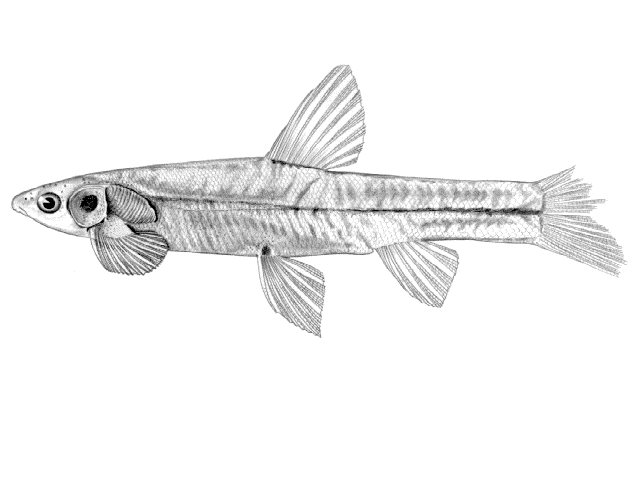
Kneria sjolandersi Poll, 1967 |
|
|
photo by
Mertens, P. |
| Family: | Kneriidae (Shellears) | |||
| Max. size: | 6.8 cm TL (male/unsexed) | |||
| Environment: | benthopelagic; freshwater | |||
| Distribution: | Africa: Rio Cubal (Bero River tributary) and streams in the Serra da Chela mountains (part of the Bero and possibly also Coroca River drainages) in Angola (Ref. 11970). | |||
| Diagnosis: | Dorsal spines (total): -0; Dorsal soft rays (total): 10-11; Anal spines: -0; Anal soft rays: 10-11. Diagnosis: body relatively compact, with short and wide head (body height 4.5-5.85 times and head length 4.25-5.7 times in SL); snout length 2.95-3.75 times in HL; eye small, its diameter 3.85-5.0 times in HL, 1.15-1.45 times in snout length; interorbital distance 2.75-3.15 times in HL; male opercular organ with small, concentric protuberances; dorsal fin origin slightly closer to caudal fin origin than to tip of snout and slightly behind pelvic fin origin; anal fin base 1-1.4 times further from pelvic fins than from caudal fin origin; pectoral fin 1-1.2 times and pelvic fin 1-1.15 times in HL; caudal peduncle short, less than 2 times longer than deep (Ref. 11970). Description: mouth inferior; caudal fin forked (Ref. 11970). Coloration: yellowish to whitish ventrally; a vague, darker longitudial line on flanks, more visible on posterior part of flanks (Ref. 11970). | |||
| Biology: | ||||
| IUCN Red List Status: | Data deficient (DD); Date assessed: 01 March 2007 Ref. (130435) | |||
| Threat to humans: | harmless | |||