
|
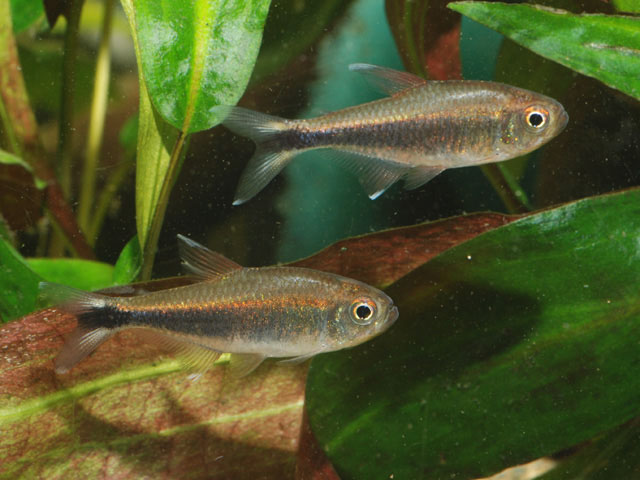
Hyphessobrycon clavatus Zarske, 2015 |
|
|
photo by
Hoffmann, P. and M. Hoffmann |
| Family: | Acestrorhamphidae (American tetras), subfamily: Hyphessobryconinae | |||
| Max. size: | 3.06 cm SL (male/unsexed) | |||
| Environment: | pelagic; freshwater | |||
| Distribution: | South America: Peru. | |||
| Diagnosis: | This species is distinguished by the following characters: undeveloped humeral spot and the dark diffuse longitudinal band is indifferent developed; longitudinal band starts behind the operculum or below the dorsal fin and runs to the tips of the middle rays of the caudal fin; a golden or silvery stripe above the longitudinal band is not developed; body relatively short and high, looks somewhat like a club, body depth 3.04 (2.69-3.32) times in body length; maxillary bone with (mean) 6 (6.40, 4-8) conical to tricuspid teeth; outer row of the praemaxillary bone are in the mean 2 (1.68. 1-3 ) tricuspid teeth; in a longitudinal row are 31 (31.27. 30-32) scales; lateral line relatively short and has developed in the mean 5 (5.18, 4-6) pored scales; in males, ventral fins reach beyond the origin of anal fin, not in the females; presence of small hooks on the first 6-7 divided fin rays of the anal fin of the males, also on the first fin rays of the ventral fins; 4 (4.18. 3-5) scales are on the beginning of the base of anal fin; vertebrae mean 32 (32.72, 32-33); branched (?) anal fin rays, mean 19 (18.81, 17-20) (Ref. 105293). | |||
| Biology: | ||||
| IUCN Red List Status: | Not Evaluated (N.E.) Ref. (130435) | |||
| Threat to humans: | harmless | |||