
|
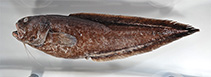
Hoplobrotula badia Machida, 1990 |
|
|
photo by
Senou, H. |
| Family: | Ophidiidae (Cusk-eels), subfamily: Neobythitinae | |||
| Max. size: | 55.8 cm SL (male/unsexed) | |||
| Environment: | demersal; marine | |||
| Distribution: | Northwest Pacific: Sagami Bay, Japan. | |||
| Diagnosis: | Dorsal soft rays (total): 94-94; Anal soft rays: 79; Vertebrae: 53-53. Rather elongate body with blunt head; eye almost as long as snout; upper jaws ends well behind eye; 3 sharp spines on preopercle and 1strong opercular spine; 1 median and a pair of basibranchial tooth patches; 5-6 developed rakers on anterior gill arch; pelvic fins inserted beneath eye and extended well beyond head; precaudal vertebrae 13 (Ref. 34024). Snout spine present (Ref. 34024). | |||
| Biology: | Rare species (Ref. 34024). Reproductive strategy possibly similar to other members of this family featuring oviparity, with oval pelagic eggs floating in a gelatinous mass (Ref. 205). | |||
| IUCN Red List Status: | Least Concern (LC); Date assessed: 16 August 2019 Ref. (130435) | |||
| Threat to humans: | harmless | |||