
|
Glossogobius callidus (Smith, 1937) |
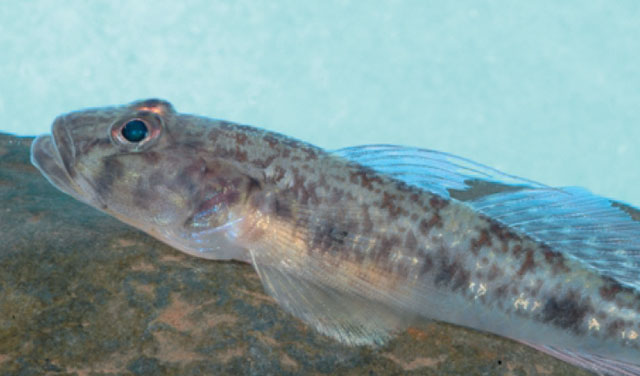
|
|
photo by
Keith, P. |
| Family: | Gobiidae (Gobies), subfamily: Gobiinae | |||
| Max. size: | 12 cm TL (male/unsexed) | |||
| Environment: | benthopelagic; freshwater; brackish | |||
| Distribution: | Africa: east coast rivers from Mozambique south to the Swartvlei region of the Western Cape, South Africa (Ref. 52193). | |||
| Diagnosis: |
Dorsal spines (total): 7-7; Dorsal soft rays (total): 8-10; Anal spines: 1-1; Anal soft rays: 7-9. Description: Head depressed; snout elongate (Ref. 52193). Dorsal fin with 7 spines and 8-10 soft rays; anal fin with 1 spine and 7-9 soft rays; pectoral fin with 14-19 rays; caudal fin pointed (Ref. 52193). Scales in lateral series 28-32; nape partially naked, without scales; predorsal scales 0-13 (Ref. 52193). Colouration: Translucent brown with black X-spots along sides; black spot on hind membrane of first dorsal fin; soft dorsal with black and yellow spots and bars (Ref. 52193). Dark stripe from eye to upper lip; vertical bar or spot at caudal base (Ref. 2798). |
|||
| Biology: | Inhabits estuaries and river systems (Ref. 92840); lives in poolson the bottom amongst cover such as cobbles or vegetation (Ref. 52193). It feeds on bottom-living insects and small invertebrates (Ref. 52193). Breeds in early summer; eggs are oval (Ref. 52193). | |||
| IUCN Red List Status: | Least Concern (LC); Date assessed: 02 July 2016 Ref. (130435) | |||
| Threat to humans: | harmless | |||