
|
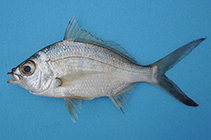
Gerres simillimus Regan, 1907 |
|
|
photo by
Béarez, P. |
| Family: | Gerreidae (Mojarras) | |||
| Max. size: | 41 cm TL (male/unsexed) | |||
| Environment: | reef-associated; brackish; marine; depth range 0 - 30 m | |||
| Distribution: | Eastern Pacific: Mexico (southern Baja and the lower Gulf of California) to Peru, and the Galapagos. | |||
| Diagnosis: | Dorsal spines (total): 9-9; Dorsal soft rays (total): 10-10; Anal spines: 2-2; Anal soft rays: 7-7. Body color silvery white with about 8 faint dark bars on side, pelvic and anal fins are yellowish; body deep (depth 2.3-2.7 in SL); highly extensible mouth, pointing downward when protruded; lower border of preopercle is smooth, bone under front of eye with smooth border; D IX,10; A II,7; large scales conspicuous and finely rough, covering most of the head and body; 39-44 lateral line scales (Ref. 93032). | |||
| Biology: | Inhabits sand bottoms adjacent to reefs and also entering brackish estuaries (Ref. 93032). Feeds on insects (Ref. 93032). | |||
| IUCN Red List Status: | Least Concern (LC); Date assessed: 25 May 2007 Ref. (130435) | |||
| Threat to humans: | harmless | |||