
|
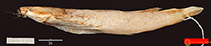
Clarias lamottei Daget & Planquette, 1967 |
|
|
photo by
MNHN |
| Family: | Clariidae (Airbreathing catfishes) | |||
| Max. size: | 16.4 cm TL (male/unsexed) | |||
| Environment: | demersal; freshwater | |||
| Distribution: | Africa: Nzi River, tributary of the Bandama, Côte d'Ivoire. | |||
| Diagnosis: | Dorsal spines (total): 0-0; Dorsal soft rays (total): 53-58; Anal soft rays: 51-52; Vertebrae: 56. Characterized by a relatively short vomerine tooth plates (3.6-3.9 % HL) and by its relatively long adipose fin (12.7-15.9 % SL) - the longest in Clarias and therefore, is a specific character for C. lamottei. Head is oval-shaped in dorsal outline. Frontal fontanelle long and narrow (`knife-shaped'); occipital fontanelle long and oval-shaped. Suprabranchial organ consists of well developed arborescent structures. | |||
| Biology: | The type locality is situated in a savannah area, in a swamp which completely dries up every year (Ref. 248). | |||
| IUCN Red List Status: | Vulnerable (VU); Date assessed: 20 August 2019 (D2) Ref. (130435) | |||
| Threat to humans: | harmless | |||