
|
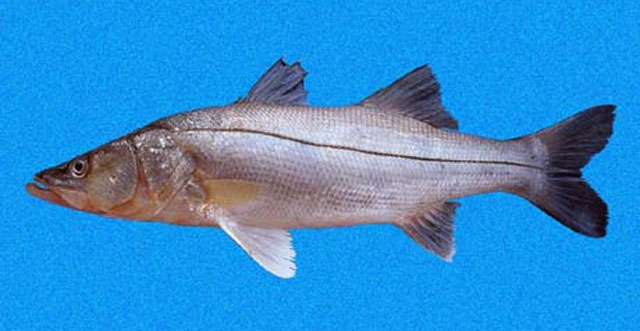
Centropomus nigrescens Günther, 1864 Black snook |
|
|
photo by
Robertson, R. |
| Family: | Centropomidae (Snooks) | |||
| Max. size: | 123 cm TL (male/unsexed); max.weight: 26 kg | |||
| Environment: | demersal; freshwater; brackish; marine | |||
| Distribution: | Eastern Pacific: southern Baja California, Mexico and mouth of the Gulf of California to Colombia and Peru. | |||
| Diagnosis: | Body slender and not very deep; dorsal profile slightly concave behind the eyes; lateral line extending to posterior edge of caudal fin; second anal spine, when folded down, well removed from origin of caudal fin; pectoral and pelvic fins sub-equal; anal fin with 6 rays; back blue gray; belly white; lateral line very dark; fins charcoal gray (Ref. 55763). | |||
| Biology: | Adults enter mangrove areas and lagoons. Also occur in estuaries (Ref. 11035) and fresh water (Ref. 4537), as well as rustic ponds (Ref. 85798). | |||
| IUCN Red List Status: | Least Concern (LC); Date assessed: 09 November 2018 Ref. (130435) | |||
| Threat to humans: | harmless | |||