
|
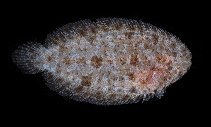
Aseraggodes andersoni Randall & Bogorodsky, 2013 |
|
|
photo by
Randall, J.E. |
| Family: | Soleidae (Soles) | |||
| Max. size: | 2.35 cm SL (male/unsexed) | |||
| Environment: | reef-associated; marine; depth range 1 - 2 m | |||
| Distribution: | Western Indian Ocean: Maldives only but expected to occur in other tropical countries in the area. | |||
| Diagnosis: | Dorsal spines (total): 0-0; Dorsal soft rays (total): 68-68; Anal spines: 0-0; Anal soft rays: 49-49; Vertebrae: 37-37. This species is distinguished by the following characters: D 68; A 49; lateral-line scales 71; vertebrae 37; dorsal pterygiophores anterior to fourth neural spine 9; body depth 2.4 in SL; head length 4.1 in SL; no caudal peduncle; snout length 2.95 in head length; colour in alcohol uniformly pale yellowish brown, when fresh pale brown with numerous, irregular, bluish white blotches, scattered small dark brown spots, and with 3 rows of large brown blotches (one at base of dorsal fin, one at base of anal fin, and one along lateral line); a large orange-red area over abdomen and posterior head; iris light yellow with spoke-like brown bands; median fins with a row of large dark brown spots at the base, and smaller spots peripherally (Ref. 95111). | |||
| Biology: | ||||
| IUCN Red List Status: | Data deficient (DD); Date assessed: 17 June 2019 Ref. (130435) | |||
| Threat to humans: | harmless | |||