
|
Apistogramma steindachneri (Regan, 1908) |
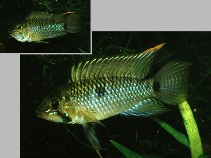
|
|
photo by
DATZ |
| Family: | Cichlidae (Cichlids), subfamily: Geophaginae | |||
| Max. size: | 6.53 cm SL (male/unsexed); 7 cm TL (female) | |||
| Environment: | benthopelagic; freshwater; pH range: 6.19999980926514 - 6.80000019073486; dH range: 3 - 10, non-migratory | |||
| Distribution: | South America: Essequibo, Demerara and Mahaica River drainages, and from the Marowijne River to the Corantijn River basin. | |||
| Diagnosis: | ||||
| Biology: | One male has a harem of several females; 60-120 eggs are laid in caves; male defends all nesting sites (Ref. 13371). Eggs are deposited on the ceiling of caves (Ref. 47893). Largest male measures 6.53 cm SL (Ref. 98797). | |||
| IUCN Red List Status: | Not Evaluated (N.E.) Ref. (130435) | |||
| Threat to humans: | harmless | |||