This website uses cookies to enhance your browsing experience and ensure the functionality of our site. For more detailed information about the types of cookies we use and how we protect your privacy, please visit our Privacy Information page.
×
Cookie Settings
This website uses different types of cookies to enhance your experience. Please select your preferences below:
Eastern Atlantic: Mauritania (Ref. 5377) to Angola, becoming scarce north of Cape Verde. Often confused with Pseudotolithus senegalensis.
Length at first maturity / Size / Weight / Age
Maturity: Lm48.3 range ? - ? cm Max length : 140 cm TL male/unsexed; (Ref. 40637); common length : 50.0 cm SL male/unsexed; (Ref. 4780); max. published weight: 15.0 kg (Ref. 40637)
Short description Identification keys | Morphology | Morphometrics
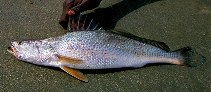
Dorsalspines (total): 10; Dorsalsoft rays (total): 28 - 32. Diagnosis: dorsal fin with 9 spines in the 1st part and 1 spine and 28-32 in the second; second anal spine about half the length of the 1st anal fin soft ray; pectoral fins short, about 19-21% SL; gill rakers short, about as long as gill filament at angle between lower and upper part of gill arch; maxilla extending beyond posterior eye border, eyes small, 7.2-8.4 times in HL, but this character is difficult to use for identification because of allometry (Ref. 81656). Body shape (shape guide): fusiform / normal.
Inhabits coastal waters from shoreline to about 150 m depth, over mud and sandy mud bottoms. Most abundant in waters less than 60 m at temperatures above 18°C. Juveniles and sub-adults enter estuaries and rivers. Feeds mainly on small fishes and crustaceans. Peak spawning season from late spring to early autumn in tropical West Africa (Ref. 4780).
Life cycle and mating behavior Maturity | Reproduction | Spawning | Eggs | Fecundity | Larvae
Chao, L.N. and E. Trewavas, 1990. Sciaenidae. p. 813-826. In J.C. Quero, J.C. Hureau, C. Karrer, A. Post and L. Saldanha (eds.) Check-list of the fishes the eastern tropical Atlantic (CLOFETA). JNICT, Lisbon; SEI, Paris; and UNESCO, Paris. Vol. 2. (Ref. 3593)
IUCN Red List Status (Ref. 130435: Version 2025-2)