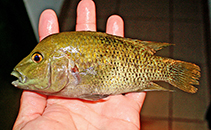
Herichthys pratinus

You can sponsor this page

Herichthys pratinus De, la, Maza-Benignos & Lozano-Vilano, 2013

Adicionar o seu Fotografias e vídeos
Fotografias | Imagem do Google
Image of Herichthys pratinus
Herichthys pratinus
Male Fotografia de De la Maza-Benignos, M.


Mexico country information

Common names: Green cichlid, Mojarra caracolera verde
Occurrence: native
Salinity: freshwater
Abundance: | Ref:
Importance: | Ref:
Aquaculture: | Ref:
Regulations: | Ref:
Uses: no uses
Comments: Occurs only in the Rio el Salto, which runs through the Sierra La Colmena, in San Luis Potosi. Considered as Herichthys labridens ,listed as threatened by the NOM-059-ECOL-2010 and endangered by the IUCN Red List of Threatened Species (Ref. 94458).
National Checklist:
Country Information: https://www.cia.gov/library/publications/resources/the-world-factbook/geos/mx.html
National Fisheries Authority:
Occurrences: Occurrences Point map
Main Ref: de la Maza-Benignos, M. and Ma. De L. Lozano-Villano, 2013
National Database:

Common names from other countries

Classificação / Names Nomes comuns | Sinónimos | Catalog of Fishes(Género, Espécies) | ITIS | CoL | WoRMS | Cloffa

> Cichliformes (Cichlids, convict blennies) > Cichlidae (Cichlids) > Cichlinae
Etymology: Herichthys: Greek, eri = very, a lot + Greek, ichthys = fish (Ref. 45335)pratinus: From the Latin word for green, in allusion to its greenish color.

Issue
Junior synonym of Herichthys pantostictus according to Pérez-Miranda et al., 2020 (Ref. 126993:11); this record will be deleted.

Environment: milieu / climate zone / intervalo de profundidade / distribution range Ecologia

; Água doce bentopelágico. Tropical

Distribuição Países | Áreas FAO | Ecossistemas | Ocorrências | Mapa dos pontos | Introduções | Faunafri

Central America: endemic to the Rio el Salto in Mexico.

Tamanho / Peso / Idade

Maturidade: Lm ?  range ? - ? cm
Max length : 12.1 cm SL macho/indeterminado; (Ref. 94458)

Descrição breve Chaves de identificação | Morfologia | Morfometria

Espinhos dorsais (total) : 15 - 16; Raios dorsais moles (total) : 10 - 11; Espinhos anais: 5; Raios anais moles: 8 - 9. This species is diagnosed by having predorsal contour steep and flat, concave before eye, and prominent forehead, forming a nuchal hump in adult males. Dorsal and ventral contours are conic, straight to moderately convex, making intersection with caudal peduncle conspicuous. This is also distinguished using the following combination characters: distance from anal fin origin to hypural base (mean 36%, SD 1%); mouth slightly angled downward; lower pharyngeal plate moderately stout and broad; 2 rows of 8-9 stout molars increasing in size posteriorly and molarization flank the midline, 4 most posterior molars flattened; and spiny dorsal fin rays V (Ref. 94458).
Body shape (shape guide): fusiform / normal.

Biologia     Glossário (ex. epibenthic)

This species is syntopic in the lower courses of the Rio el Salto with H. cf. carpintis, Astyanax mexicanus, Xiphohorus nezahualcoyotl, and Poecilia mexicana along with other species of fishes in higher reaches (Ref. 94458).

Life cycle and mating behavior Maturidade | Reprodução | Desova | Ovos | Fecundidade | Larvas

Referência principal Upload your references | Referências | Coordenador : Kullander, Sven O. | Colaboradores

de la Maza-Benignos, M. and Ma. De L. Lozano-Villano, 2013. Description of three new species of the genus Herichthys (Perciformes: Cichlidae) from eastern Mexico, with redescription of H. labridens, H. steindachneri, and H. pantostictus. Zootaxa 3734(2):101-129. (Ref. 94458)

Categoria na Lista Vermelha da IUCN (Ref. 130435: Version 2025-1)


CITES

Not Evaluated

CMS (Ref. 116361)

Not Evaluated

Ameaça para o homem

  Harmless


Utilização humana

FAO - Publication: search | FishSource |

Mais informação

Ecologia Trófica
Food items (preys)
Composição da dieta
Consumo alimentar
Food rations
Predadores
Ecologia
Ecologia
Home ranges
Population dynamics
Parâmetros de crescimento
Max. ages / sizes
Length-weight rel.
Length-length rel.
Frequência de comprimento
Mass conversion
Recrutamento
Abundância
Life cycle
Reprodução
Maturidade
Maturity/Gills rel.
Fecundidade
Desova
Spawning aggregations
Ovos
Desenvolvimento dos ovos
Larvas
Dinâmica larvar
Distribuição
Países
Áreas FAO
Ecossistemas
Ocorrências
Introduções
BRUVS - Videos
Anatomy
Área branquial
Brain
Otolith
Physiology
Body composition
Nutrients
Consumo de oxigénio
Tipo de natação
Velocidade de natação
Visual pigments
Fish sound
Diseases & Parasites
Toxicity (LC50s)
Genética
genoma
Genética
Heterozygosity
Hereditariedade
Human related
Aquaculture systems
Perfis para aquacultura
Estirpes
Ciguatera cases
Stamps, coins, misc.
Outreach
Colaboradores
Referências
Referências

Ferramentas

Relatórios especiais

Descarregue XML

Fontes da internet

AFORO (otoliths) | Aquatic Commons | BHL | Cloffa | Websites from users | Consultar FishWatcher | CISTI | Catalog of Fishes: Género, Espécies | DiscoverLife | ECOTOX | FAO - Publication: search | Faunafri | Fishipedia | Fishtrace | GloBI | Google Books | Google Scholar | Google | IGFA World Record | OneZoom | Open Tree of Life | Otolith Atlas of Taiwan Fishes | PubMed | Reef Life Survey | Socotra Atlas | TreeBase | Árvore da vida | Wikipedia: ir para, procurar | Zoobank | Registo zoológico

Estimates based on models

Phylogenetic diversity index (Ref. 82804):  PD50 = 0.5001   [Uniqueness, from 0.5 = low to 2.0 = high].
Bayesian length-weight: a=0.02291 (0.01064 - 0.04934), b=3.07 (2.89 - 3.25), in cm total length, based on LWR estimates for this (Sub)family-body shape (Ref. 93245).
Nível Trófico (Ref. 69278):  3.3   ±0.1 se; based on size and trophs of closest relatives
Resiliência (Ref. 120179):  Elevada, tempo mínimo de duplicação da população menor que 15 meses (Preliminary K or Fecundity.).
Fishing Vulnerability (Ref. 59153):  Low vulnerability (10 of 100). 🛈