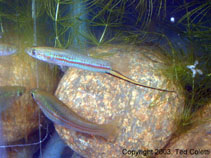
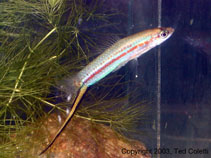
Xiphophorus clemenciae, Yellow swordtail : fisheries, aquarium

You can sponsor this page

Xiphophorus clemenciae Álvarez, 1959

Yellow swordtail
Upload your photos and videos
Pictures | Google image


Mexico country information

Common names: Coatzacoalcos swordtail, Espada de Clemencia, Espada de Clemencia
Occurrence: endemic
Salinity: freshwater
Abundance: common (usually seen) | Ref: Kallman, K.D., R.B. Walter, D.C. Morizot and S. Kazianis, 2004
Importance: | Ref:
Aquaculture: | Ref:
Regulations: | Ref:
Uses: no uses
Comments: Known from the Coatzacoalcos and Papaloapan ecoregions (Ref. 81264). Found in Oaxaca, Rio Sarabia (Ref. 42936). Reported widespread and abundant, but restricted to the uplands of the Rio Coatzacolacos basin (Ref. 52914). Status of threat: threatened; status declined since 1989. Criteria: 1,5 (http://fisc.er.usgs.gov/afs/) (Ref. 81264).
National Checklist:
Country Information: https://www.cia.gov/library/publications/resources/the-world-factbook/geos/mx.html
National Fisheries Authority:
Occurrences: Occurrences Point map
Main Ref: Kallman, K.D., R.B. Walter, D.C. Morizot and S. Kazianis, 2004
National Database:

Common names from other countries

Classification / Names Common names | Synonyms | Catalog of Fishes(genus, species) | ITIS | CoL | WoRMS | Cloffa

Teleostei (teleosts) > Cyprinodontiformes (Rivulines, killifishes and live bearers) > Poeciliidae (Poeciliids) > Poeciliinae
Etymology: Xiphophorus: Greek, xiphos = sword + Greek, pherein = to carry (Ref. 45335).
Eponymy: Clemence Álvarez was the wife of the author Dr José Álvarez del Villar (1903–1986). (Ref. 128868), visit book page.

Environment: milieu / climate zone / depth range / distribution range Ecology

Freshwater; benthopelagic; pH range: 7.2 - 8.0; dH range: 3 - 10; non-migratory. Tropical; 22°C - 26°C (Ref. 2060)

Distribution Countries | FAO areas | Ecosystems | Occurrences | Point map | Introductions | Faunafri

North America: Coatzacoalcos and Papaloapan ecoregions in Mexico.

Size / Weight / Age

Maturity: Lm ?  range ? - ? cm
Max length : 5.1 cm SL male/unsexed; (Ref. 42936)

Biology     Glossary (e.g. epibenthic)

Common in small streams and brooks with light current and rockpools in areas with extensive limestone outcroppings; relatively uncommon in fast-flowing streams (Ref. 52914).

Life cycle and mating behavior Maturity | Reproduction | Spawning | Eggs | Fecundity | Larvae

After a gestation period of 24-28 days, female gives birth to 10-15 young (Ref. 2060).

Main reference Upload your references | References | Coordinator | Collaborators

Rodriguez, C.M., 1997. Phylogenetic analysis of the tribe Poeciliini (Cyprinodontiformes: Poeciliidae). Copeia 1997(4):663-679. (Ref. 26855)

IUCN Red List Status (Ref. 130435: Version 2025-1)

  Data deficient (DD) ; Date assessed: 24 October 2018

CITES

Not Evaluated

CMS (Ref. 116361)

Not Evaluated

Threat to humans

  Harmless


Human uses

Fisheries: commercial; aquarium: commercial
FAO - Publication: search | FishSource |

More information

Trophic ecology
Food items (preys)
Diet composition
Food consumption
Food rations
Predators
Ecology
Ecology
Home ranges
Population dynamics
Growth parameters
Max. ages / sizes
Length-weight rel.
Length-length rel.
Length-frequencies
Mass conversion
Recruitment
Abundance
Life cycle
Reproduction
Maturity
Maturity/Gills rel.
Fecundity
Spawning
Spawning aggregations
Eggs
Egg development
Larvae
Larval dynamics
Distribution
Countries
FAO areas
Ecosystems
Occurrences
Introductions
BRUVS - Videos
Anatomy
Gill area
Brain
Otolith
Physiology
Body composition
Nutrients
Oxygen consumption
Swimming type
Swimming speed
Visual pigments
Fish sound
Diseases & Parasites
Toxicity (LC50s)
Genetics
Genome
Genetics
Heterozygosity
Heritability
Human related
Aquaculture systems
Aquaculture profiles
Strains
Ciguatera cases
Stamps, coins, misc.
Outreach
Collaborators
Taxonomy
Common names
Synonyms
Morphology
Morphometrics
Pictures
References
References

Tools

Special reports

Download XML

Internet sources

AFORO (otoliths) | Aquatic Commons | BHL | Cloffa | Websites from users | Check FishWatcher | CISTI | Catalog of Fishes: genus, species | DiscoverLife | ECOTOX | FAO - Publication: search | Faunafri | Fishipedia | Fishtrace | GloBI | Google Books | Google Scholar | Google | IGFA World Record | OneZoom | Open Tree of Life | Otolith Atlas of Taiwan Fishes | Public aquariums | PubMed | Reef Life Survey | Socotra Atlas | TreeBase | Tree of Life | Wikipedia: Go, Search | Zoobank | Zoological Record

Estimates based on models

Phylogenetic diversity index (Ref. 82804):  PD50 = 0.5000   [Uniqueness, from 0.5 = low to 2.0 = high].
Bayesian length-weight: a=0.00851 (0.00374 - 0.01935), b=3.14 (2.95 - 3.33), in cm total length, based on LWR estimates for this (Sub)family-body shape (Ref. 93245).
Trophic level (Ref. 69278):  3.1   ±0.4 se; based on size and trophs of closest relatives
Resilience (Ref. 120179):  High, minimum population doubling time less than 15 months (Preliminary K or Fecundity.).
Fishing Vulnerability (Ref. 59153):  Low vulnerability (10 of 100). 🛈
Price category (Ref. 80766):   Unknown.