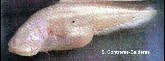
Typhliasina pearsei, Mexican blind brotula

You can sponsor this page

Typhliasina pearsei (Hubbs, 1938)

Mexican blind brotula
Upload your photos and videos
Immagini | Google image
Image of Typhliasina pearsei (Mexican blind brotula)
Typhliasina pearsei
Picture by Contreras-Balderas, S.


Mexico country information

Common names: Dama blanca ciega, Dama Ciega Blanca, Mexican blind brotula
Occurrence: endemic
Salinity: freshwater
Abundance: occasional (usually not seen) | Ref: Nielsen, J.G., D.M. Cohen, D.F. Markle and C.R. Robins, 1999
Importance: of no interest | Ref: Nielsen, J.G., D.M. Cohen, D.F. Markle and C.R. Robins, 1999
Aquaculture: | Ref:
Regulations: | Ref:
Uses: no uses
Comments: Occurs in the Yucatan Peninsula (Ref. 34024). Type locality, pool in Balaam Canche Cave near Chichen Itza, Yucatán (Ref. 33021). Also Ref. 3881, 27299, 79893. Status of threat: endangered; status same as 1989. Criteria: 1,5 (http://fisc.er.usgs.gov/afs/) (Ref. 81264).
National Checklist:
Country Information: https://www.cia.gov/library/publications/resources/the-world-factbook/geos/mx.html
National Fisheries Authority:
Occurrences: Occurrences Point map
Main Ref: Nielsen, J.G., D.M. Cohen, D.F. Markle and C.R. Robins, 1999
National Database:

Common names from other countries

Classification / Names Nomi Comuni | Sinonimi | Catalog of Fishes(Genere, Specie) | ITIS | CoL | WoRMS | Cloffa

> Ophidiiformes (Cusk eels) > Dinematichthyidae (Viviparous brotula)
Eponymy: Dr Arthur Sperry Pearse (1877–1956) was an American zoologist. [...] (Ref. 128868), visit book page.
More on author: Hubbs.

Environment: milieu / climate zone / distribuzione batimetrica / distribution range Ecologia

; acqua dolce demersale; distribuzione batimetrica 0 - 70 m (Ref. 55786). Tropical; 21°N - 20°N

Distribuzione Stati | Aree FAO | Ecosystems | Presenze | Mappa dei ritrovamenti | Introduzioni | Faunafri

Central America: Yucatan Peninsula, Mexico.

Size / Peso / Age

Maturità: Lm ?  range ? - ? cm
Max length : 9.7 cm SL maschio/sesso non determinato; (Ref. 55786); 8.9 cm SL (female)

Short description Chiavi di identificazione | Morfologia | Morfometria

Raggi dorsali molli (totale) : 75 - 87; Raggi anali molli: 59 - 68; Vertebre: 40 - 43. This species is distinguished by the following characters: anterior nostril placed low on snout; tip of opercular spine free; 2 pairs of psedoclaspers, inner one positioned in front of outer one; eyes not visible (eyes minute black dots in specimens less than 20 mm SL); head naked; otolith with fused colliculi; 3 lower preopercular pores; maxillary strongly vertically expanded posteriorly, knob at rear corner; 5-7 prolonged rakers on anterior gill arch; anterior anal fin pterygiophore elongated; pseudobranchial filaments absent (Ref. 55786).

Biologia     Glossario (es. epibenthic)

Uncommon species found in caves and sinkholes (Ref. 34024). Associated with the blind synbranchid fish Ophisternon infernale (Hubbs, 1938) and several blind crustacean species. In only one cave, it was found with the catfish Rhamdia guatemalensis (Günther, 1864). This species does not react to flashlights, but darted away at the slightest vibration; it seems to feed on troglobitic shrimps and mysids. Newly-born juveniles are light yellow and about 20 mm long (Ref. 55786).

Life cycle and mating behavior Maturità | Riproduzione | Deposizione | Uova | Fecundity | Larve

Viviparous.

Main reference Upload your references | Bibliografia | Coordinatore | Collaboratori

Møller, P.R., W. Schwarzhans and J.G. Nielsen, 2004. Review of the American Dinematichthyini (Teleostei, Bythitidae). Part I. Dinematichthys, Gunterichthys, Typhliasina and two new genera. aqua, J. Ichthyol. Aquat. Biol. 8(4):141-192. (Ref. 55786)

IUCN Red List Status (Ref. 130435: Version 2025-1)

  Near Threatened (NT) ; Date assessed: 05 October 2018

CITES

Not Evaluated

CMS (Ref. 116361)

Not Evaluated

Threat to humans

  Harmless


Human uses

Pesca: di nessun interesse
FAO - Publication: search | FishSource |

Informazioni ulteriori

Trophic ecology
Food items (preys)
Alimentazione
Consumo di cibo
Food rations
Predatori
Ecologia
Ecologia
Home ranges
Population dynamics
Growth parameters
Max. ages / sizes
Length-weight rel.
Length-length rel.
Length-frequencies
Mass conversion
Reclutamento
Abbondanza
Life cycle
Riproduzione
Maturità
Maturity/Gills rel.
Fecundity
Deposizione
Spawning aggregations
Uova
Egg development
Larve
Dinamica popolazioni larvali
Distribuzione
Stati
Aree FAO
Ecosystems
Presenze
Introduzioni
BRUVS - Videos
Anatomy
Area branchiale
Brain
Otolith
Physiology
Body composition
Nutrients
Oxygen consumption
Swimming type
Swimming speed
Visual pigments
Fish sound
Diseases & Parasites
Toxicity (LC50s)
Genetica
Genome
Genetica
Heterozygosity
Ereditarietà
Human related
Aquaculture systems
Profili di acquacoltura
Varietà
Ciguatera cases
Stamps, coins, misc.
Outreach
Collaboratori
Taxonomy
Nomi Comuni
Sinonimi
Morfologia
Morfometria
Immagini
Bibliografia
Bibliografia

Strumenti

Special reports

Download XML

Fonti Internet

AFORO (otoliths) | Aquatic Commons | BHL | Cloffa | Websites from users | Check FishWatcher | CISTI | Catalog of Fishes: Genere, Specie | DiscoverLife | ECOTOX | FAO - Publication: search | Faunafri | Fishipedia | Fishtrace | GloBI | Google Books | Google Scholar | Google | IGFA World Record | OneZoom | Open Tree of Life | Otolith Atlas of Taiwan Fishes | PubMed | Reef Life Survey | Socotra Atlas | TreeBase | Tree of Life | Wikipedia: Go, ricerca | Zoological Record

Estimates based on models

Phylogenetic diversity index (Fonte Biblio. 82804):  PD50 = 1.0000   [Uniqueness, from 0.5 = low to 2.0 = high].
Bayesian length-weight: a=0.00389 (0.00180 - 0.00842), b=3.12 (2.94 - 3.30), in cm total length, based on all LWR estimates for this body shape (Ref. 93245).
Trophic level (Fonte Biblio. 69278):  3.4   ±0.5 se; based on size and trophs of closest relatives
Resilienza (Fonte Biblio. 120179):  Basso, tempo minimo di raddoppiamento della popolazione 4.5 - 14 anni (Assuming Fec < 100).
Fishing Vulnerability (Ref. 59153):  Low vulnerability (10 of 100). 🛈