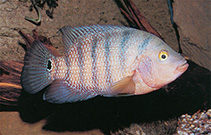
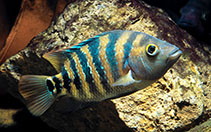
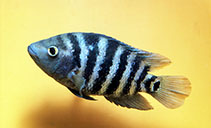
Common names from other countries
Classification / Names
Nomi Comuni | Sinonimi | Catalog of Fishes(Genere, Specie) | ITIS | CoL | WoRMS | Cloffa
>
Cichliformes (Cichlids, convict blennies) >
Cichlidae (Cichlids) > Cichlinae
Etymology: Mayaheros: Named for the native Mesoamerican Maya people whose ancestral distribution includes most of the native area of the M. urophthalmus group, very likely the ancestral area of the whole genus. The name is combined with the old cichlid genus name Heros (meaning hero), to be understood as the hero of the Maya people (Ref. 114771).
Eponymy: Named after the Mayan people who inhabit the areas of Central America where these fish occur. [...] (Ref. 128868), visit book page.
More on author: Günther.
Environment: milieu / climate zone / distribuzione batimetrica / distribution range
Ecologia
; acqua dolce; salmastro benthopelagico; distribuzione batimetrica 2 - ? m (Ref. 7335). Tropical; 20°C - 39°C (Ref. 35127); 27°N - 11°N, 98°W - 80°W (Ref. 55201)
Central America: Atlantic drainages from Mexico to Nicaragua.
Length at first maturity / Size / Peso / Age
Maturità: Lm 13.2, range 10 - 19 cm
Max length : 39.4 cm TL maschio/sesso non determinato; (Ref. 40637); peso massimo pubblicato: 1.1 kg (Ref. 40637)
Short description
Chiavi di identificazione | Morfologia | Morfometria
Inhabit freshwater marshes and mangrove swamps. Adults prefer coastal lagoons and rivers and will tolerate marine conditions. Feed on small fishes and macro-invertebrates (Ref. 7335). Spawn on the bottom in both fresh and brackish water (Ref. 35127).
Max. 600 eggs.
Page, L.M. and B.M. Burr, 1991. A field guide to freshwater fishes of North America north of Mexico. Houghton Mifflin Company, Boston. 432 p. (Ref. 5723)
IUCN Red List Status (Ref. 130435: Version 2025-1)
Threat to humans
Harmless
Human uses
Pesca: commerciale; Acquacoltura: commerciale; Pesce da pesca sportiva: si; Acquario: Commerciale
Strumenti
Special reports
Download XML
Fonti Internet
Estimates based on models
Phylogenetic diversity index (Fonte Biblio.
82804): PD
50 = 0.5001 [Uniqueness, from 0.5 = low to 2.0 = high].
Bayesian length-weight: a=0.02951 (0.02278 - 0.03824), b=3.04 (2.97 - 3.11), in cm total length, based on LWR estimates for this species (Ref.
93245).
Trophic level (Fonte Biblio.
69278): 3.9 ±0.57 se; based on food items.
Generation time: 6.7 ( na - na) years. Estimated as median ln(3)/K based on 2
growth studies.
Resilienza (Fonte Biblio.
120179): Medio, tempo minimo di raddoppiamento della popolazione 1.4 - 4.4 anni (K=0.16-0.20; tmax=7; Fec=2,085-6,615).
Fishing Vulnerability (Ref.
59153): Moderate vulnerability (44 of 100).
🛈