Common names from other countries
>
Eupercaria/misc (Various families in series Eupercaria) >
Sparidae (Porgies)
Etymology: Lagodon: Greek, lagos = hare + Greek, odous = teeth (Ref. 45335).
More on author: Linnaeus.
Environment: milieu / climate zone / пределы глубины / distribution range
экология
морской; пресноводный; солоноватоводный демерсальный; пределы глубины 6 - 30 m (Ref. 44885). Subtropical; 42°N - 18°N, 98°W - 64°W
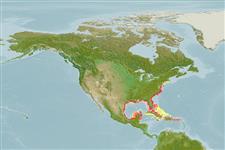
Western Atlantic: Massachusetts (USA), Bermuda, and northern Gulf of Mexico to Florida Keys, USA and Yucatan, Mexico. Also in northern coast of Cuba; absent in Bahamas or rest of Antilles (Ref. 26938).
Length at first maturity / Size / Вес / Возраст
половая зрелость: Lm 13.1, range 9 - 17.3 cm
Max length : 40.0 cm TL самец/пол неопределен; (Ref. 3815); common length : 18.0 cm TL самец/пол неопределен; (Ref. 3815); наибольший вес (опубликованные данные): 1.5 kg (Ref. 40637)
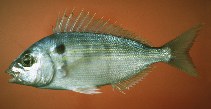
Commonly found on vegetated bottoms, occasionally over rocky bottoms and in mangrove areas. Enters brackish water and even freshwaters. Often forms large aggregations. Feeds mainly on small animals, especially crustaceans, but also takes mollusks, worms and occasionally small fishes that are associated with the grassy habitat. Depth range based on the depth at which this species was captured by trawls during a baitfish survey (Ref. 44885); to be replaced with a better reference.
Robins, C.R. and G.C. Ray, 1986. A field guide to Atlantic coast fishes of North America. Houghton Mifflin Company, Boston, U.S.A. 354 p. (Ref. 7251)
Статус Красного Списка МСОП (Ref. 130435: Version 2025-1)
Угроза для людей
Harmless
Использование человеком
рыболовство: не имеет хозяйственного значения; объект спортивного рыболовства: да; наживка: usually
дополнительная информация
инструменты
Специальные отчеты
Скачать в формате XML
ресурсы в Интернет
Estimates based on models
Preferred temperature (ссылка
123201): 22.8 - 26.7, mean 24.3 °C (based on 181 cells).
Phylogenetic diversity index (ссылка
82804): PD
50 = 1.0000 [Uniqueness, from 0.5 = low to 2.0 = high].
Bayesian length-weight: a=0.01349 (0.01201 - 0.01516), b=3.05 (3.02 - 3.08), in cm total length, based on LWR estimates for this species (Ref.
93245).
Trophic level (ссылка
69278): 4.4 ±0.0 se; based on diet studies.
устойчивость к внешним воздействиям (ссылка
120179): средний (среднего размера), минимальное время удвоения популяции 1.4-4.4 года (tmax=7; k >0.30).
Fishing Vulnerability (Ref.
59153): Low to moderate vulnerability (34 of 100).
🛈
Nutrients (Ref.
124155): Calcium = 88.2 [51.7, 185.8] mg/100g; Iron = 1.09 [0.60, 1.99] mg/100g; Protein = 20.3 [19.3, 21.4] %; Omega3 = 0.429 [0.269, 0.714] g/100g; Selenium = 17 [8, 36] μg/100g; VitaminA = 13.9 [4.2, 44.4] μg/100g; Zinc = 0.762 [0.506, 1.100] mg/100g (wet weight);