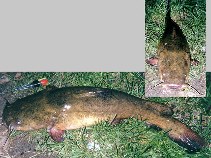
Common names from other countries
>
Siluriformes (Catfishes) >
Ictaluridae (North American freshwater catfishes)
Etymology: Pylodictis: Greek, pylos = mud + Greek, ichthys = fish (Ref. 45335); olivaris: olivarus meaning olive colored (Ref. 10294).
More on author: Rafinesque.
Environment: milieu / climate zone / intervalo de profundidade / distribution range
Ecologia
; Água doce demersal. Subtropical; ? - 33°C (Ref. 12741); 47°N - 26°N, 108°W - 80°W (Ref. 86798)
North America: Lower Great Lakes and Mississippi River basins from western Pennsylvania to White-Little Missouri River system in North Dakota, and south to Louisiana in USA; Gulf Slope from Mobile Bay drainage in Georgia and Alabama in USA to Mexico. Transplanted elsewhere in USA.
Length at first maturity / Tamanho / Peso / Idade
Maturidade: Lm 48.3, range 46 - 50.8 cm
Max length : 155 cm TL macho/indeterminado; (Ref. 86798); peso máx. Publicado: 55.8 kg (Ref. 40637); Idade máx. registada: 25 anos (Ref. 120825)
Adults inhabit pools with logs and other debris in low-gradient to moderate-gradient, small to large rivers. Also found in lakes and impoundments. Young occur in rocky and sandy runs and riffles (Ref. 5723, 86798). Juveniles feed on aquatic insect immature in riffle areas (Ref. 10294). Older individuals consume crayfish, clams and fishes (Ref. 93252).
Page, L.M. and B.M. Burr, 2011. A field guide to freshwater fishes of North America north of Mexico. Boston : Houghton Mifflin Harcourt, 663p. (Ref. 86798)
Categoria na Lista Vermelha da IUCN (Ref. 130435: Version 2025-1)
Ameaça para o homem
Harmless
Utilização humana
Pescarias: espécies comerciais; peixe desportivo: sim; Aquário: Aquários públicos
Ferramentas
Relatórios especiais
Descarregue XML
Fontes da internet
Estimates based on models
Phylogenetic diversity index (Ref.
82804): PD
50 = 1.0000 [Uniqueness, from 0.5 = low to 2.0 = high].
Bayesian length-weight: a=0.00575 (0.00432 - 0.00766), b=3.11 (3.03 - 3.19), in cm total length, based on LWR estimates for this species (Ref.
93245).
Nível Trófico (Ref.
69278): 3.8 ±0.3 se; based on diet studies.
Generation time: 7.8 (6.9 - 9.5) years. Estimated as median ln(3)/K based on 24
growth studies.
Resiliência (Ref.
120179): Baixo, tempo mínimo de duplicação da população 4,5 - 14 anos (K=0.06-0.38; tm=3-6; tmax=34; Fec=6,900).
Fishing Vulnerability (Ref.
59153): High vulnerability (62 of 100).
🛈
Nutrients (Ref.
124155): Calcium = 32.2 [18.3, 73.4] mg/100g; Iron = 1.17 [0.65, 2.08] mg/100g; Protein = 17.1 [15.0, 18.9] %; Omega3 = 0.467 [0.192, 1.143] g/100g; Selenium = 77.9 [32.5, 172.5] μg/100g; VitaminA = 14.8 [5.0, 45.4] μg/100g; Zinc = 0.595 [0.403, 0.893] mg/100g (wet weight);