Common names from other countries
>
Siluriformes (Catfishes) >
Ictaluridae (North American freshwater catfishes)
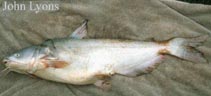
Etymology: Ictalurus: Greek, ichtys = fish + Greek, ailouros = cat (Ref. 45335); furcatus: The specific name furcatus meaning forked, referring to the deeply forked caudal fin (Ref. 10294).
More on author: Valenciennes.
Issue
Ictalurus meridionalis (Günther 1864) is tentatively valid in CofF after Gilbert (1998).
Environment: milieu / Klimaatzone / Diepte / distribution range
Ecologie
; zoet water; brak water demersaal; diepte ? - 50 m (Ref. 125908). Subtropical; 44°N - 15°N, 108°W - 80°W (Ref. 86798)
North America: USA (Mississippi River basin from western Pennsylvania to southern South Dakota and Platte River in southwestern Nebraska, south to Gulf; Gulf Slope from Escambia River drainage (where introduced), Alabama and Florida, to Rio Grande drainage in Texas and New Mexico; and Mexico. Introduced in Atlantic Slope drainages, western states, and Minnesota.
Grootte / Gewicht / Leeftijd
Maturiteit: Lm ? range ? - ? cm
Max length : 165 cm TL mannelijk / geslacht onbekend; (Ref. 86798); max. gepubliceerd gewicht: 68.0 kg (Ref. 9988); max. gerapporteerde leeftijd: 21 Jaren (Ref. 12193)
Korte beschrijving
Determinatiesleutels | Morfologie | Morfometrie
Inhabits deep water of impoundments and main channels and backwaters of medium to large rivers, over mud, sand and gravel (Ref. 5723, 86798). Stays on the bottom during the day in deep areas and moves into swifter water at night to feed (Ref. 117513). Feeds on small aquatic invertebrates, clams and fishes (Ref. 93252). Prefers clear, strongly flowing water. Deposits eggs in nests under under logs, brush, or riverbank (Ref. 117513). Males build nest often in pools or backwaters (Ref. 117513). Marketed fresh and frozen. Eaten steamed, fried, broiled, microwaved and baked (Ref. 9988).
Levenscyclus en paargedrag
Maturiteit | Voortplanting | Paaien | Eieren | Fecunditeit | Larven
Page, L.M. and B.M. Burr, 2011. A field guide to freshwater fishes of North America north of Mexico. Boston : Houghton Mifflin Harcourt, 663p. (Ref. 86798)
Status op de Rode Lijst van het IUCN (Ref. 130435: Version 2025-1)
Gevaar voor de mens
Harmless
Gebruik door de mens
Visserij: commercieel; Aquacultuur: commercieel; sportvis: ja; Aquarium: Publieke aquaria
Tools
Speciale rapporten
Download XML
Internetbronnen
Estimates based on models
Fylogenetische diversiteitsindex (Ref.
82804): PD
50 = 0.5010 [Uniqueness, from 0.5 = low to 2.0 = high].
Bayesian length-weight: a=0.00525 (0.00303 - 0.00910), b=3.11 (2.96 - 3.26), in cm total length, based on LWR estimates for this species & (Sub)family-body (Ref.
93245).
Trofisch niveau (Ref.
69278): 3.4 ±0.44 se; based on food items.
Weerstandsvermogen (Ref.
120179): laag, minimale populatieverdubbelingstijd 4,5-14 jaar (tmax=21).
Fishing Vulnerability (Ref.
59153): High to very high vulnerability (70 of 100).
🛈
Nutrients (Ref.
124155): Calcium = 30.3 [18.0, 71.8] mg/100g; Iron = 0.834 [0.512, 1.441] mg/100g; Protein = 16.6 [14.7, 18.6] %; Omega3 = 0.378 [0.200, 0.729] g/100g; Selenium = 48.7 [26.5, 98.1] μg/100g; VitaminA = 5.97 [2.38, 14.97] μg/100g; Zinc = 0.64 [0.45, 0.88] mg/100g (wet weight);