Common names from other countries
Environment: milieu / climate zone / profondeur / distribution range
Écologie
; eau douce; saumâtre démersal; pH range: 7.0 - 25.0; dH range: 10 - 15; profondeur 0 - ? m (Ref. 55225), usually 0 - ? m (Ref. 55225). Subtropical; 12°C - 20°C (Ref. 2060); 48°N - 23°N, 99°W - 69°W (Ref. 55225)
North and Central America: Atlantic Slope from Delaware River in New Jersey to central Florisa; St. Lawrence River in Quebec through Great Lakes and Mississippi River basin to Red River (Hudson Bay basin), North Dakota, and south to Louisiana; Gulf Slope drainages from central Florida to Rio Grande drainage in Texas and Mexico.
Length at first maturity / Taille / Poids / Âge
Maturité: Lm 66.9 range ? - 80 cm
Max length : 200 cm TL mâle / non sexé; (Ref. 40637); common length : 17.5 cm TL mâle / non sexé; (Ref. 12193); poids max. publié: 22.8 kg (Ref. 4699); âge max. reporté: 36 années (Ref. 12193)
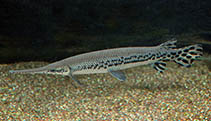
Épines dorsales (Total) : 0; Rayons mous dorsaux (Total) : 6 - 9; Épines anales: 0; Rayons mous anaux: 8 - 10. Long narrow snout. Olivaceous brown above and white below. Dark spots on median fins and on body (Ref. 37032). Scales ganoid: thin bony scutes on leading edges of unpaired fins, and on both edges of caudal fin (Ref. 4639).
Body shape (shape guide): elongated; Cross section: circular.
Facultative air-breathing (Ref. 126274); Adults occur in sluggish pools, backwaters and oxbows of medium to large rivers, and lakes (Ref. 10294). Usually found near vegetation. Occasionally found in brackish waters. Spawning occur in freshwater and possibly slightly brackish water (Ref. 4639). Migrate up rivers during the spawning season (Ref. 4639). Eggs and larvae are demersal and adhesive (Ref. 4639). Voracious predator, feeding on various fishes and crustaceans. The roe is poisonous.
Robins, C.R., R.M. Bailey, C.E. Bond, J.R. Brooker, E.A. Lachner, R.N. Lea and W.B. Scott, 1991. Common and scientific names of fishes from the United States and Canada. Am. Fish. Soc. Spec. Publ. (20):183 p. (Ref. 3814)
Statut dans la liste rouge de l'IUCN (Ref. 130435: Version 2025-1)
Menace pour l'homme
Other
Utilisations par l'homme
Pêcheries: intérêt commercial mineur; pêche sportive: oui; Aquarium: Aquariums publics
Outils
Articles particuliers
Télécharger en XML
Sources Internet
Estimates based on models
Phylogenetic diversity index (Réf.
82804): PD
50 = 0.5801 [Uniqueness, from 0.5 = low to 2.0 = high].
Bayesian length-weight: a=0.00126 (0.00061 - 0.00262), b=3.19 (2.99 - 3.39), in cm total length, based on LWR estimates for this species & (Sub)family-body (Ref.
93245).
Niveau trophique (Réf.
69278): 4.2 ±0.73 se; based on food items.
Generation time: 9.5 ( na - na) years. Estimated as median ln(3)/K based on 2
growth studies.
Résilience (Réf.
120179): Faible, temps minimum de doublement de population : 4,5 à 14 années (tm=3-6; tmax=36; Fec=1,110).
Fishing Vulnerability (Ref.
59153): High vulnerability (63 of 100).
🛈
Nutrients (Ref.
124155): Calcium = 36.9 [20.7, 68.2] mg/100g; Iron = 0.887 [0.535, 1.485] mg/100g; Protein = 18.7 [17.7, 19.6] %; Omega3 = 0.266 [0.160, 0.452] g/100g; Selenium = 48.4 [27.2, 91.1] μg/100g; VitaminA = 6.85 [2.62, 18.68] μg/100g; Zinc = 0.456 [0.333, 0.653] mg/100g (wet weight);