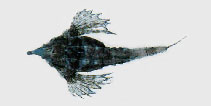
Pegasus laternarius : fisheries

You can sponsor this page

Pegasus laternarius Cuvier, 1816

Add your observation in Fish Watcher
Native range | All suitable habitat | Point map | Year 2050
This map was computer-generated and has not yet been reviewed.
Pegasus laternarius   AquaMaps   Data sources: GBIF OBIS
Upload your photos and videos
Bilder | Google image
Image of Pegasus laternarius
Pegasus laternarius
Picture by Yang, N.-S.


Japan country information

Common names: [No common name]
Occurrence: native
Salinity: marine
Abundance: | Ref:
Importance: | Ref:
Aquaculture: | Ref:
Regulations: | Ref:
Uses: no uses
Comments: Recorded from southern Japan (Ref. 48635).
National Checklist:
Country Information: https://www.cia.gov/library/publications/resources/the-world-factbook/geos/ja.html
National Fisheries Authority: http://www.maff.go.jp/eindex.html
Occurrences: Occurrences Point map
Main Ref: Palsson, W.A. and T.W. Pietsch, 1989
National Database:

Common names from other countries

Classification / Names Populärnamn | synonymer | Catalog of Fishes(Släkte, Arter) | ITIS | CoL | WoRMS | Cloffa

> Dactylopteriformes (Flying gurnards) > Pegasidae (Seamoths)
Etymology: Pegasus: Named after the winged horse sprung from the blood of Medusa (Ref. 1418)laternarius: From the Latin word 'later' meaning made of bricks.
More on author: Cuvier.

Environment: milieu / climate zone / djupintervall / distribution range Ekologi

marina bottenlevande; djupintervall 30 - 100 m (Ref. 48635). Tropical; 35°N - 11°S, 77°E - 139°E

Utbredning Länder | FAO områden | Ekosystem | Förekomster | Prickkarta | Utplanteringar | Faunafri

Indo-West Pacific: Gulf of Manaar, Indian Ocean to the Western Pacific (Gulf of Thailand and South China Sea, along the coast of southern China and Taiwan, extending as far north as Suruga Bay, Japan).

Size / Vikt / Age

Könsmognad: Lm ?  range ? - ? cm
Max length : 8.0 cm SL hane/ej könsbestämd; (Ref. 1418)

Short description Bestämningsnycklar | Morfologi | Morfometri

Taggstrålar i ryggfenan (totalt) : 0; Mjukstrålar i ryggfenan (totalt) : 5; Taggstrålar i analfenan: 0; Mjukstrålar i analfenan: 5; Ryggkotor: 20. It has a variety of colors and can be dull to bright yellow or blue (Ref. 48635). Preserved body dark brown dorsally and laterally; lighter ventrally. Species with 4 pairs of dorsolateral body plates; 5 pairs ventrolateral body plates; deep pits on dorsal surface of head and within interorbital depression absent; 11 or more tail rings with 9th and 10th fused; suborbital shelf convex, obscuring eye from ventral view; last tail ring without spine on dorsal surface. 5th rays of pectorals stout, much thicker than other rays. No scales on orbit. Distal margin of dorsal and anal fins oblique to horizontal axis of body. Readily identified by its rather short rostrum when juvenile or female; it is more developed in males (Ref. 48635).
Body shape (shape guide): other; Cross section: flattened.

Biologi     Ordlista (t.ex. epibenthic)

Adults lives on muddy bottoms, often collected at depths of about 50 m; larvae are planktonic. Rarely seen diving, except a few localities in Japan where they occur in sheltered muddy habitats (Ref. 48635).

Life cycle and mating behavior Könsmognad | Reproduktion | Lek | Ägg | Fecundity | Larver

Main reference Upload your references | referenser | Koordinator | Medarbetare

Palsson, W.A. and T.W. Pietsch, 1989. Revision of the Acanthopterygian fish Family Pegasidae (Order Gasterosteiformes). Indo-Pac. Fish. (18):38 p. (Ref. 1418)

IUCN Red List Status (Ref. 130435: Version 2025-1)

  Data deficient (DD) ; Date assessed: 11 May 2016

CITES

Not Evaluated

CMS (Ref. 116361)

Not Evaluated

Threat to humans

  Harmless


Human uses

Fiskeri: av potentiellt intresse
FAO - Publication: search | FishSource |

Ytterligare information

Trophic ecology
Food items (preys)
Födosammansättning
Födointag
Food rations
Predatorer
Ekologi
Ekologi
Home ranges
Population dynamics
Tillväxtparametrar
Max. ages / sizes
Length-weight rel.
Length-length rel.
Length-frequencies
Mass conversion
Rekrytering
Abundans
Life cycle
Reproduktion
Könsmognad
Maturity/Gills rel.
Fecundity
Lek
Spawning aggregations
Ägg
Egg development
Larver
Larvdynamik
Utbredning
Länder
FAO områden
Ekosystem
Förekomster
Utplanteringar
BRUVS - Videos
Anatomy
Gälyta
Brain
Otolith
Physiology
Body composition
Nutrients
Syreförbrukning
Swimming type
Simhastighet
Visual pigments
Fish sound
Diseases & Parasites
Toxicity (LC50s)
Genetik
Genome
Genetik
Heterozygosity
Ärftlighet
Human related
Aquaculture systems
Vattenbruksprofiler
Avelslinjer
Ciguatera cases
Stamps, coins, misc.
Outreach
Medarbetare
Taxonomy
Populärnamn
synonymer
Morfologi
Morfometri
Bilder
referenser
referenser

Verktyg

Special reports

Download XML

Internet-källor

AFORO (otoliths) | Aquatic Commons | BHL | Cloffa | Websites from users | Check FishWatcher | CISTI | Catalog of Fishes: Släkte, Arter | DiscoverLife | ECOTOX | FAO - Publication: search | Faunafri | Fishipedia | Fishtrace | GloBI | Google Books | Google Scholar | Google | IGFA World Record | Nationella databaser | OneZoom | Open Tree of Life | Otolith Atlas of Taiwan Fishes | PubMed | Reef Life Survey | Socotra Atlas | TreeBase | Tree of Life | Wikipedia: Go, sök | Zoobank | Zoological Record

Estimates based on models

Preferred temperature (Ref. 123201): 23.4 - 28.4, mean 27.4 °C (based on 329 cells).
Phylogenetic diversity index (Ref. 82804):  PD50 = 0.5391   [Uniqueness, from 0.5 = low to 2.0 = high].
Bayesian length-weight: a=0.01000 (0.00244 - 0.04107), b=3.04 (2.81 - 3.27), in cm total length, based on all LWR estimates for this body shape (Ref. 93245).
Trofisk nivå (Ref. 69278):  3.3   ±0.4 se; based on size and trophs of closest relatives
Fishing Vulnerability (Ref. 59153):  Low vulnerability (10 of 100). 🛈
Price category (Ref. 80766):   Unknown.