Teleostei (teleosts) >
Carangaria/misc (Various families in series Carangaria) >
Polynemidae (Threadfins)
Etymology: Leptomelanosoma: Greek, leptos = thin + Greek, melanos = black + Greek, soma = body.
More on author: Shaw.
Environment: milieu / climate zone / depth range / distribution range
Ecology
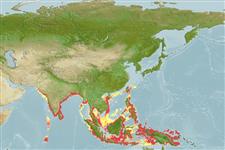
Marine; brackish; demersal; amphidromous (Ref. 51243); depth range 55 - 100 m (Ref. 9685). Tropical; 26°N - 10°S, 62°E - 152°E (Ref. 57343)
Indo-West Pacific: known with certainty from Pakistan to Papua New Guinea. Reports from the east coast of Africa need to be verified (Ref. 57343).
Size / Weight / Age
Maturity: Lm ? range ? - ? cm
Max length : 142 cm TL male/unsexed; (Ref. 3479); common length : 80.0 cm TL male/unsexed; (Ref. 3479)
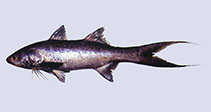
Occurs over shallow muddy and sandy bottoms of the continental shelf), mainly near estuaries and sometimes entering rivers (Ref. 57343). Feeds mainly on small benthic crustaceans, especially prawns and crabs, and small fishes. Percentage of fishes eaten increases with size. Utilized fresh, dried or salted and frozen; eaten steamed, pan-fried, broiled and baked (Ref. 9987).
Life cycle and mating behavior
Maturity | Reproduction | Spawning | Eggs | Fecundity | Larvae
Motomura, H. and Y. Iwatsuki, 2001. A new genus, Leptomelanosoma, for the polynemid fish previously known as Polydactylus indicus (Shaw, 1804) and a redescription of the species. Ichthyol. Res. 48(1):13-21. (Ref. 45350)
IUCN Red List Status (Ref. 130435)
Threat to humans
Harmless
Human uses
Fisheries: commercial; gamefish: yes
More information
Common namesSynonymsMetabolismPredatorsEcotoxicologyReproductionMaturitySpawningSpawning aggregationFecundityEggsEgg development
Tools
Special reports
Download XML
Internet sources
Estimates based on models
Preferred temperature (Ref.
123201): 23.7 - 28.1, mean 26.3 °C (based on 82 cells).
Phylogenetic diversity index (Ref.
82804): PD
50 = 1.0000 [Uniqueness, from 0.5 = low to 2.0 = high].
Bayesian length-weight: a=0.00562 (0.00269 - 0.01173), b=3.06 (2.87 - 3.25), in cm total length, based on LWR estimates for this (Sub)family-body shape (Ref.
93245).
Trophic level (Ref.
69278): 3.9 ±0.67 se; based on food items.
Generation time: 5.8 ( na - na) years. Estimated as median ln(3)/K based on 1
growth studies.
Resilience (Ref.
120179): Medium, minimum population doubling time 1.4 - 4.4 years (K=0.19).
Fishing Vulnerability (Ref.
59153): High vulnerability (60 of 100).
Nutrients (Ref.
124155): Calcium = 44.4 [16.8, 164.2] mg/100g; Iron = 0.51 [0.19, 1.46] mg/100g; Protein = 19.8 [18.0, 21.4] %; Omega3 = 0.143 [0.081, 0.241] g/100g; Selenium = 83.8 [45.1, 159.8] μg/100g; VitaminA = 9.34 [4.42, 19.15] μg/100g; Zinc = 1.37 [0.51, 2.69] mg/100g (wet weight); based on
nutrient studies.