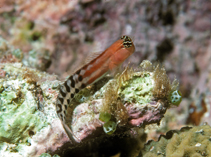
Teleostei (teleosts) >
Blenniiformes (Blennies) >
Blenniidae (Combtooth blennies) > Salariinae
Etymology: Ecsenius: Greek, exenios, -os, -on = uncontrolled, immoderate; fijiensis: Named in reference to its presumed endemicity in Fiji.
Environment: milieu / climate zone / depth range / distribution range
Ecology
Marine; reef-associated; depth range 0 - 24 m (Ref. 5296). Tropical
Western Central Pacific: endemic to Fiji Islands.
Size / Weight / Age
Maturity: Lm ? range ? - ? cm
Max length : 3.9 cm SL male/unsexed; (Ref. 5296)
Short description
Identification keys | Morphology | Morphometrics
Dorsal spines (total): 12; Dorsal soft rays (total): 13 - 14; Anal spines: 2; Anal soft rays: 15 - 16; Vertebrae: 31 - 33. Dorsal fin XII, 13 or 14, deeply notched between spinous and segmented-ray portions. Anal fin II,15 or 16. Pectoral fin 13 or 14 (rarely 14). Caudal fin 13. Vertebrae 10 + 21-23 (usually 22). Dentary incisor teeth 36-50 which includes anterior canine teeth very similar in appearance
with incisors; posterior canines usually 1 on each side. Lateral line lacking vertical pairs of pores, terminating posteriorly at point between verticals from dorsal-fin spines 10 and 12
(typically at 12). With cirrus on posterior rim of anterior nostril; absent on anterior rim.
Body shape (shape guide): elongated; Cross section: oval.
Oviparous. Eggs are demersal and adhesive (Ref. 205), and are attached to the substrate via a filamentous, adhesive pad or pedestal (Ref. 94114). Larvae are planktonic, often found in shallow, coastal waters (Ref. 94114).
Life cycle and mating behavior
Maturity | Reproduction | Spawning | Eggs | Fecundity | Larvae
Oviparous, distinct pairing (Ref. 205).
Springer, V.G., 1988. The Indo-Pacific blenniid fish genus Ecsenius. Smithson. Contrib. Zool. (465):134 p. (Ref. 5296)
IUCN Red List Status (Ref. 130435: Version 2025-2)
Threat to humans
Harmless
Human uses
Tools
Special reports
Download XML
Internet sources