



Tympanopleura rondoni (Miranda Ribeiro, 1914)
Ladda upp din foton och Videor
Google image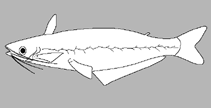 No image available for this species;
drawing shows typical species in Auchenipteridae.
Google image
drawing shows typical species in Auchenipteridae.
Klassificering / Namn Populärnamn | synonymer | Catalog of Fishes(Släkte, Arter) | ITIS | CoL | WoRMS | Cloffa
> Siluriformes (Catfishes) > Auchenipteridae (Driftwood catfishes) > Auchenipterinae
Etymology: Tympanopleura: Greek, tympanon = drum + Greek, pleura = pleura.
Eponymy: Marshall Cândido Mariano da Silva Rondon (1865–1958) was a Brazilian army officer (1881–1955) engineer and explorer, whose Rondon Commission was responsible for installing telegraph poles from Mato Grosso to Amazonas. [...] (Ref. 128868), visit book page.
Etymology: Tympanopleura: Greek, tympanon = drum + Greek, pleura = pleura.
Eponymy: Marshall Cândido Mariano da Silva Rondon (1865–1958) was a Brazilian army officer (1881–1955) engineer and explorer, whose Rondon Commission was responsible for installing telegraph poles from Mato Grosso to Amazonas. [...] (Ref. 128868), visit book page.
Miljö: miljö / Klimatzon / djupintervall / distributionsområde Ekologi
; sötvatten bentopelagisk. Tropical
Utbredning Territorier | FAO områden | Ekosystem | Förekomster | Prickkarta | Utplanteringar | Faunafri
South America: central Amazon River basin, including the rio Madeira in Brazil, and the río Mamoré and río Guaporé in Bolivia.
Storlek / Vikt / Ålder
Könsmognad: Lm ? range ? - ? cm
Max length : 17.4 cm SL hane/ej könsbestämd; (Ref. 125975); publicerad maxvikt: 104.67 g (Ref. 125975)
Max length : 17.4 cm SL hane/ej könsbestämd; (Ref. 125975); publicerad maxvikt: 104.67 g (Ref. 125975)
Kort beskrivning Bestämningsnycklar | Morfologi | Morfometri
Taggstrålar i ryggfenan (totalt) : 2; Mjukstrålar i ryggfenan (totalt) : 6; Mjukstrålar i analfenan: 28 - 37; Ryggkotor: 38 - 42. Tympanopleura rondoni is distinguished by having more robust body shape and larger maximum size (about 160 mm SL) than congeners (all less than 120 mm SL in the material examined). It possesses a unique, prominently spotted pigmentation pattern on the head,
body, and fins, and an elongated gas bladder with two moderately long, recurved terminal posterior diverticula. It can be further diagnosed from T. atronasus in having a greater number of anal-fin rays (28-37, mode 31 vs. 23-30, mode 27), more pectoral-fin rays (10-13 vs. 7-9), more gill rakers on the first arch (24-33 vs. 14-23), fewer preanal vertebrae (14-16, mode 15 vs. 16-19, mode 17), fewer pairs of pleural ribs (4-6 vs. 7-8), greater distance from pectoral- to dorsal-fin origin (19.8-29.0% SL vs. 15.7-20.9% SL), slightly greater body width at pectoral-fin origin (21.8-29.5% SL vs. 17.8-22.9% SL), slightly longer pectoral-fin spine (17.1-21.0% SL vs. 13.3-19.0% SL), and a smaller eye diameter (8.4-17.0% HL vs. 16.0-27.8% HL). It differs from T. brevis in having more gill rakers (24-33, mode 29-30 vs. 20-24, mode 23), a slightly shorter-pectoral fin spine (17.1-21.0% SL vs. 19.1- 24.4% SL), and a smaller eye (8.4-17.0% HL vs. 13.8-21.0% HL); otherwise, these two species are differentiated mainly on the basis of pigmentation pattern and structure of the gas bladder. It is dintict from T. cryptica in having a longer anal fin (anal-fin rays 28-37, mode 31 vs. 23-30, mode 29), more pectoral-fin rays (10-13, mode 11 vs. 8-10, mode 9), more gill rakers (24-33, mode 29-30 vs. 21-26, mode 22), greater number of total vertebrae (38- 42, mode 40 vs. 38-41, mode 38), pleural rib pairs (4-6, mode 6 vs. 4-5, mode 5), and a smaller eye (8.4-17.0% HL vs. 16.7-25.6% HL). It can be separated from T. longipinna in having a somewhat shorter anal fin (anal-fin rays 28-37, mode 31 vs. 32-42, mode 37), more gill rakers (24-33, mode 29-30 vs. 19-25, mode 23), fewer total vertebrae (38-42, mode 40 vs. 40-43, mode 43), pleural rib pairs (4-6, mode 6 vs. 4-5, mode 5), longer predorsal length (35.2-47.4% SL vs. 29.5-36.1% SL), shorter distance from pelvic- to adipose-fin origin (24.0-41.5% SL vs. 37.6-45.1% SL), shorter distance from dorsal- to adipose-fin origin (38.1-46.8% SL vs. 46.5-54.0% SL), and a shorter anal-fin base (23.1-32.5% SL vs. 33.9-39.9% SL). It is distinguisged from T. piperata in having more pectoralfin rays (10-13, mode 11 vs. 6-10, mode 9), more gill rakers (24-33 vs. 16-23), pleural ribs pairs (4-6, mode 6 vs. 4-5, mode 4), longer prepectoral length (29.2-39.0% SL vs. 23.6-28.3% SL), greater distance from pectoral- to dorsal fin origin (19.8-29.0% SL vs. 15.2-20.9% SL), greater body width at pectoral-fin origin (21.8-29.5% SL vs. 16.8-20.0% SL), shorter anal-fin base (23.1-32.5% SL vs. 30.9-39.3% SL), longer head (26.5-39.0% SL vs. 22.2-27.8% SL), longer snout (41.7-53.6% SL vs. 31.4-43.6% SL), proportionally longer jaws and a wider gape, and a smaller eye (8.4-17.0% HL vs. 24.3-35.7% HL) (Ref. 103256).
Livscykel och parningsbeteende Könsmognad | Reproduktion | Lek | Ägg | Fekunditet | Larver
Huvudreferens
Ladda upp dina referenser | referenser | Koordinator : Ferraris, Jr., Carl J. | Medarbetare
Walsh, S.J., F.R.V. Ribeiro and L.H. Rapp Py-Daniel, 2015. Revision of Tympanopleura Eigenmann (Siluriformes: Auchenipteridae) with description of two new species. Neotrop. Ichthyol. 13(1):1-46. (Ref. 103256)
Status på IUCN:s rödlista (Ref. 130435: Version 2025-2 (Global))
Least Concern (LC) ; Date assessed: 20 August 2020
CITES
Not Evaluated
Hot mot människor
Harmless
Mänskliga användningsområden
FAO - Publication: search | FishSource |
Ytterligare information
Trofisk ekologi
Livsmedelsartiklar (preys)
Födosammansättning
Födointag
Matransoner
Predatorer
Livsmedelsartiklar (preys)
Födosammansättning
Födointag
Matransoner
Predatorer
Populationsdynamik
Tillväxtparametrar
Max. åldrar / storlekar
Längd-vikt rel.
Längd-längd rel.
Längd-frekvenser
Massakonvertering
Rekrytering
Abundans
Tillväxtparametrar
Max. åldrar / storlekar
Längd-vikt rel.
Längd-längd rel.
Längd-frekvenser
Massakonvertering
Rekrytering
Abundans
Livscykel
Reproduktion
Könsmognad
Mognad/Gills rel.
Fekunditet
Lek
Lekande aggregat
Ägg
Utveckling av ägg
Larver
Larvdynamik
Reproduktion
Könsmognad
Mognad/Gills rel.
Fekunditet
Lek
Lekande aggregat
Ägg
Utveckling av ägg
Larver
Larvdynamik
Anatomi
Gälyta
Hjärna
Otolit
Gälyta
Hjärna
Otolit
Fysiologi
Kroppssammansättning
Näringsämnen
Syreförbrukning
Typ av simning
Simhastighet
Visuella pigment
Ljud från fisk
Sjukdomar & Parasiter
Toxicitet (LC50)
Kroppssammansättning
Näringsämnen
Syreförbrukning
Typ av simning
Simhastighet
Visuella pigment
Ljud från fisk
Sjukdomar & Parasiter
Toxicitet (LC50)
Genetik
Genom
Genetik
Heterozygositet
Ärftlighet
Genetisk mångfald
Genom
Genetik
Heterozygositet
Ärftlighet
Genetisk mångfald
Människorelaterad
Vattenbrukssystem
Vattenbruksprofiler
Avelslinjer
Ciguatera-fall
Frimärken, mynt, diverse.
Vattenbrukssystem
Vattenbruksprofiler
Avelslinjer
Ciguatera-fall
Frimärken, mynt, diverse.
Verktyg
Särskilda rapporter
Kontrollera för underhåll av akvarium | Kontrollera om det finns faktablad om arter | Kontrollera om det finns faktablad om vattenbruk
Ladda ner XML
Internet-källor
AFORO (otoliths) | Aquatic Commons | BHL | Cloffa | Websites from users | Check FishWatcher | CISTI | Catalog of Fishes: Släkte, Arter | DiscoverLife | ECOTOX | FAO - Publication: search | Faunafri | Fishipedia | Fishtrace | GloBI | Google Books | Google Scholar | Google | IGFA World Record | OneZoom | Open Tree of Life | Otolith Atlas of Taiwan Fishes | PubMed | Reef Life Survey | Socotra Atlas | TreeBase | Tree of Life | Wikipedia: Go, sök | World Records Freshwater Fishing | Zoologiskt register
Uppskattningar baserade på modeller
Index för fylogenetisk mångfald (Ref. 82804): PD50 = 0.5156 [Uniqueness, from 0.5 = low to 2.0 = high].
Bayesian length-weight: a=0.01318 (0.00682 - 0.02548), b=3.09 (2.92 - 3.26), in cm total length, based on LWR estimates for this species & (Sub)family-body (Ref. 93245).
Trofisk nivå (Ref. 69278): 3.4 ±0.4 se; based on size and trophs of closest relatives
Resiliens (Ref. 120179): Hög, lägsta populationsfördubblingstid mindre än 15 månader (Preliminary K or Fecundity.).