



Tympanopleura rondoni (Miranda Ribeiro, 1914)
Hochladen Photos und videos
Google Bild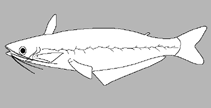 No image available for this species;
drawing shows typical species in Auchenipteridae.
Google Bild
drawing shows typical species in Auchenipteridae.
Klassifizierung / Names Namen | Synonyme | Catalog of Fishes(Gattung, Arten) | ITIS | CoL | WoRMS | Cloffa
> Siluriformes (Catfishes) > Auchenipteridae (Driftwood catfishes) > Auchenipterinae
Etymology: Tympanopleura: Greek, tympanon = drum + Greek, pleura = pleura.
Eponymy: Marshall Cândido Mariano da Silva Rondon (1865–1958) was a Brazilian army officer (1881–1955) engineer and explorer, whose Rondon Commission was responsible for installing telegraph poles from Mato Grosso to Amazonas. [...] (Ref. 128868), visit book page.
Etymology: Tympanopleura: Greek, tympanon = drum + Greek, pleura = pleura.
Eponymy: Marshall Cândido Mariano da Silva Rondon (1865–1958) was a Brazilian army officer (1881–1955) engineer and explorer, whose Rondon Commission was responsible for installing telegraph poles from Mato Grosso to Amazonas. [...] (Ref. 128868), visit book page.
Umwelt: Milieu / Klimazone / Tiefenbereich / Verbreitungsgebiet Ökologie
; süßwasser benthopelagisch. Tropical
Verbreitung Territorien | FAO Gebiete | Ökosysteme | Vorkommen | Punkt Karte | Einführungen | Faunafri
South America: central Amazon River basin, including the rio Madeira in Brazil, and the río Mamoré and río Guaporé in Bolivia.
Größe / Gewicht / Alter
Geschlechtsreife: Lm ? range ? - ? cm
Max length : 17.4 cm SL Männchen/unbestimmt; (Ref. 125975); max. veröff. Gewicht: 104.67 g (Ref. 125975)
Max length : 17.4 cm SL Männchen/unbestimmt; (Ref. 125975); max. veröff. Gewicht: 104.67 g (Ref. 125975)
Kurzbeschreibung Bestimmungsschlüssel | Morphologie | Morphometrie
Rückenflossenstacheln (insgesamt) : 2; Rückenflossenweichstrahlen (insgesamt) : 6; Afterflossenweichstrahlen: 28 - 37; Wirbelzahl: 38 - 42. Tympanopleura rondoni is distinguished by having more robust body shape and larger maximum size (about 160 mm SL) than congeners (all less than 120 mm SL in the material examined). It possesses a unique, prominently spotted pigmentation pattern on the head,
body, and fins, and an elongated gas bladder with two moderately long, recurved terminal posterior diverticula. It can be further diagnosed from T. atronasus in having a greater number of anal-fin rays (28-37, mode 31 vs. 23-30, mode 27), more pectoral-fin rays (10-13 vs. 7-9), more gill rakers on the first arch (24-33 vs. 14-23), fewer preanal vertebrae (14-16, mode 15 vs. 16-19, mode 17), fewer pairs of pleural ribs (4-6 vs. 7-8), greater distance from pectoral- to dorsal-fin origin (19.8-29.0% SL vs. 15.7-20.9% SL), slightly greater body width at pectoral-fin origin (21.8-29.5% SL vs. 17.8-22.9% SL), slightly longer pectoral-fin spine (17.1-21.0% SL vs. 13.3-19.0% SL), and a smaller eye diameter (8.4-17.0% HL vs. 16.0-27.8% HL). It differs from T. brevis in having more gill rakers (24-33, mode 29-30 vs. 20-24, mode 23), a slightly shorter-pectoral fin spine (17.1-21.0% SL vs. 19.1- 24.4% SL), and a smaller eye (8.4-17.0% HL vs. 13.8-21.0% HL); otherwise, these two species are differentiated mainly on the basis of pigmentation pattern and structure of the gas bladder. It is dintict from T. cryptica in having a longer anal fin (anal-fin rays 28-37, mode 31 vs. 23-30, mode 29), more pectoral-fin rays (10-13, mode 11 vs. 8-10, mode 9), more gill rakers (24-33, mode 29-30 vs. 21-26, mode 22), greater number of total vertebrae (38- 42, mode 40 vs. 38-41, mode 38), pleural rib pairs (4-6, mode 6 vs. 4-5, mode 5), and a smaller eye (8.4-17.0% HL vs. 16.7-25.6% HL). It can be separated from T. longipinna in having a somewhat shorter anal fin (anal-fin rays 28-37, mode 31 vs. 32-42, mode 37), more gill rakers (24-33, mode 29-30 vs. 19-25, mode 23), fewer total vertebrae (38-42, mode 40 vs. 40-43, mode 43), pleural rib pairs (4-6, mode 6 vs. 4-5, mode 5), longer predorsal length (35.2-47.4% SL vs. 29.5-36.1% SL), shorter distance from pelvic- to adipose-fin origin (24.0-41.5% SL vs. 37.6-45.1% SL), shorter distance from dorsal- to adipose-fin origin (38.1-46.8% SL vs. 46.5-54.0% SL), and a shorter anal-fin base (23.1-32.5% SL vs. 33.9-39.9% SL). It is distinguisged from T. piperata in having more pectoralfin rays (10-13, mode 11 vs. 6-10, mode 9), more gill rakers (24-33 vs. 16-23), pleural ribs pairs (4-6, mode 6 vs. 4-5, mode 4), longer prepectoral length (29.2-39.0% SL vs. 23.6-28.3% SL), greater distance from pectoral- to dorsal fin origin (19.8-29.0% SL vs. 15.2-20.9% SL), greater body width at pectoral-fin origin (21.8-29.5% SL vs. 16.8-20.0% SL), shorter anal-fin base (23.1-32.5% SL vs. 30.9-39.3% SL), longer head (26.5-39.0% SL vs. 22.2-27.8% SL), longer snout (41.7-53.6% SL vs. 31.4-43.6% SL), proportionally longer jaws and a wider gape, and a smaller eye (8.4-17.0% HL vs. 24.3-35.7% HL) (Ref. 103256).
Lebenszyklus und Paarungsverhalten Geschlechtsreife | Fortpflanzung | Ablaichen | Eier | Fruchtbarkeit | Larven
Hauptreferenz
Laden Sie Ihre Referenzen hoch | Referenzen | Koordinator : Ferraris, Jr., Carl J. | Partner
Walsh, S.J., F.R.V. Ribeiro and L.H. Rapp Py-Daniel, 2015. Revision of Tympanopleura Eigenmann (Siluriformes: Auchenipteridae) with description of two new species. Neotrop. Ichthyol. 13(1):1-46. (Ref. 103256)
IUCN Rote Liste Status (Ref. 130435: Version 2025-2 (Global))
nicht bedroht (LC) ; Date assessed: 20 August 2020
CITES
Not Evaluated
Bedrohung für Menschen
Harmless
Nutzung durch Menschen
FAO - Publication: search | FishSource |
Mehr Information
Trophische Ökologie
Lebensmittel (Beutetiere)
Nahrungszusammensetzung
Nahrungsaufnahme
Lebensmittelrationen
Räuber
Lebensmittel (Beutetiere)
Nahrungszusammensetzung
Nahrungsaufnahme
Lebensmittelrationen
Räuber
Populationsdynamik
Wachstumsparameter
Max. Alter/Größen
Länge-Gewicht-Rel.
Länge-Länge-Verhältnis.
Längenhäufigkeiten
Massenkonvertierung
Rekrutierung
Dichte
Wachstumsparameter
Max. Alter/Größen
Länge-Gewicht-Rel.
Länge-Länge-Verhältnis.
Längenhäufigkeiten
Massenkonvertierung
Rekrutierung
Dichte
Lebenszyklus
Fortpflanzung
Geschlechtsreife
Reifung/Kiemen rel.
Fruchtbarkeit
Ablaichen
Laichaggregationen
Eier
Eientwicklung
Larven
Larven Pop.Dyn.
Fortpflanzung
Geschlechtsreife
Reifung/Kiemen rel.
Fruchtbarkeit
Ablaichen
Laichaggregationen
Eier
Eientwicklung
Larven
Larven Pop.Dyn.
Anatomie
Kiemenoberfläche
Gehirn
Otolith
Kiemenoberfläche
Gehirn
Otolith
Physiologie
Körperliche Zusammensetzung
Nährstoffe
Sauerstoffverbrauch
Schwimmart
Schwimmgeschwindigkeit
Visuelle Pigmente
Fischgeräusche
Krankheiten und Parasiten
Toxizität (LC50s)
Körperliche Zusammensetzung
Nährstoffe
Sauerstoffverbrauch
Schwimmart
Schwimmgeschwindigkeit
Visuelle Pigmente
Fischgeräusche
Krankheiten und Parasiten
Toxizität (LC50s)
Genetik
Genom
Genetik
Heterozygotie
Vererbbarkeit
Genetische Vielfalt
Genom
Genetik
Heterozygotie
Vererbbarkeit
Genetische Vielfalt
Menschenbezogen
Aquakultur-Systeme
Aquakultur Profile
Zuchtlinien
Ciguatera-Fälle
Briefmarken, Münzen, Verschiedenes.
Aquakultur-Systeme
Aquakultur Profile
Zuchtlinien
Ciguatera-Fälle
Briefmarken, Münzen, Verschiedenes.
Tools
Zusatzinformationen
Download XML
Zusammenfassung | Punktdaten | Namen | Photos
Internet Quellen
AFORO (otoliths) | Aquatic Commons | BHL | Cloffa | Websites from users | FishWatcher Einträge suchen | CISTI | Catalog of Fishes: Gattung, Arten | DiscoverLife | ECOTOX | FAO - Publication: search | Faunafri | Fishipedia | Fishtrace | GloBI | Google Books | Google Scholar | Google | IGFA World Record | OneZoom | Open Tree of Life | Otolith Atlas of Taiwan Fishes | PubMed | Reef Life Survey | Socotra Atlas | TreeBase | Tree of Life | Wikipedia: Gehe zu, Suchen | World Records Freshwater Fishing | Zoologischer Rekord
Schätzungen auf der Grundlage von Modellen
Phylogenetischer Diversitätsindex (Ref. 82804): PD50 = 0.5156 [Uniqueness, from 0.5 = low to 2.0 = high].
Bayesian length-weight: a=0.01318 (0.00682 - 0.02548), b=3.09 (2.92 - 3.26), in cm total length, based on LWR estimates for this species & (Sub)family-body (Ref. 93245).
Trophische Ebene (Ref. 69278): 3.4 ±0.4 se; based on size and trophs of closest relatives
Widerstandsfähigkeit (Ref. 120179): hoch, Verdopplung der Population dauert weniger als 15 Monate. (Preliminary K or Fecundity.).