



Tympanopleura rondoni (Miranda Ribeiro, 1914)
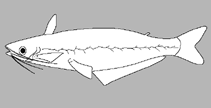
分類 / 名稱 俗名 | 同種異名 | Catalog of Fishes(屬, 種) | ITIS | CoL | WoRMS | Cloffa
Teleostei > Siluriformes (Catfishes) 鯰形目 (Catfishes) > Auchenipteridae (Driftwood catfishes) 頸鰭鯰科 (Driftwood catfishes) > Auchenipterinae
Etymology: Tympanopleura: Greek, tympanon = drum + Greek, pleura = pleura.
Eponymy: Marshall Cândido Mariano da Silva Rondon (1865–1958) was a Brazilian army officer (1881–1955) engineer and explorer, whose Rondon Commission was responsible for installing telegraph poles from Mato Grosso to Amazonas. [...] (Ref. 128868), visit book page.
Etymology: Tympanopleura: Greek, tympanon = drum + Greek, pleura = pleura.
Eponymy: Marshall Cândido Mariano da Silva Rondon (1865–1958) was a Brazilian army officer (1881–1955) engineer and explorer, whose Rondon Commission was responsible for installing telegraph poles from Mato Grosso to Amazonas. [...] (Ref. 128868), visit book page.
環境: 環境 / 氣候帶 / 深度上下限 / 配送範圍 生態學
; 淡水 底中水層性.
分布 領土 | FAO區域 | 生態系 | 發現紀錄 | 分布圖 | 簡介 | Faunafri
South America: central Amazon River basin, including the rio Madeira in Brazil, and the río Mamoré and río Guaporé in Bolivia.
大小 / 重量 / 年齡
成熟度: Lm ? range ? - ? cm
Max length : 17.4 cm SL 雄魚/尚未辨別雌雄; (Ref. 125975); 最大體重: 104.67 g (Ref. 125975)
Max length : 17.4 cm SL 雄魚/尚未辨別雌雄; (Ref. 125975); 最大體重: 104.67 g (Ref. 125975)
簡短描述 檢索表 | 型態特徵 | 形態測量圖
背棘 (總數) : 2; 背的軟條 (總數) : 6; 臀鰭軟條: 28 - 37; 脊椎骨: 38 - 42. Tympanopleura rondoni is distinguished by having more robust body shape and larger maximum size (about 160 mm SL) than congeners (all less than 120 mm SL in the material examined). It possesses a unique, prominently spotted pigmentation pattern on the head,
body, and fins, and an elongated gas bladder with two moderately long, recurved terminal posterior diverticula. It can be further diagnosed from T. atronasus in having a greater number of anal-fin rays (28-37, mode 31 vs. 23-30, mode 27), more pectoral-fin rays (10-13 vs. 7-9), more gill rakers on the first arch (24-33 vs. 14-23), fewer preanal vertebrae (14-16, mode 15 vs. 16-19, mode 17), fewer pairs of pleural ribs (4-6 vs. 7-8), greater distance from pectoral- to dorsal-fin origin (19.8-29.0% SL vs. 15.7-20.9% SL), slightly greater body width at pectoral-fin origin (21.8-29.5% SL vs. 17.8-22.9% SL), slightly longer pectoral-fin spine (17.1-21.0% SL vs. 13.3-19.0% SL), and a smaller eye diameter (8.4-17.0% HL vs. 16.0-27.8% HL). It differs from T. brevis in having more gill rakers (24-33, mode 29-30 vs. 20-24, mode 23), a slightly shorter-pectoral fin spine (17.1-21.0% SL vs. 19.1- 24.4% SL), and a smaller eye (8.4-17.0% HL vs. 13.8-21.0% HL); otherwise, these two species are differentiated mainly on the basis of pigmentation pattern and structure of the gas bladder. It is dintict from T. cryptica in having a longer anal fin (anal-fin rays 28-37, mode 31 vs. 23-30, mode 29), more pectoral-fin rays (10-13, mode 11 vs. 8-10, mode 9), more gill rakers (24-33, mode 29-30 vs. 21-26, mode 22), greater number of total vertebrae (38- 42, mode 40 vs. 38-41, mode 38), pleural rib pairs (4-6, mode 6 vs. 4-5, mode 5), and a smaller eye (8.4-17.0% HL vs. 16.7-25.6% HL). It can be separated from T. longipinna in having a somewhat shorter anal fin (anal-fin rays 28-37, mode 31 vs. 32-42, mode 37), more gill rakers (24-33, mode 29-30 vs. 19-25, mode 23), fewer total vertebrae (38-42, mode 40 vs. 40-43, mode 43), pleural rib pairs (4-6, mode 6 vs. 4-5, mode 5), longer predorsal length (35.2-47.4% SL vs. 29.5-36.1% SL), shorter distance from pelvic- to adipose-fin origin (24.0-41.5% SL vs. 37.6-45.1% SL), shorter distance from dorsal- to adipose-fin origin (38.1-46.8% SL vs. 46.5-54.0% SL), and a shorter anal-fin base (23.1-32.5% SL vs. 33.9-39.9% SL). It is distinguisged from T. piperata in having more pectoralfin rays (10-13, mode 11 vs. 6-10, mode 9), more gill rakers (24-33 vs. 16-23), pleural ribs pairs (4-6, mode 6 vs. 4-5, mode 4), longer prepectoral length (29.2-39.0% SL vs. 23.6-28.3% SL), greater distance from pectoral- to dorsal fin origin (19.8-29.0% SL vs. 15.2-20.9% SL), greater body width at pectoral-fin origin (21.8-29.5% SL vs. 16.8-20.0% SL), shorter anal-fin base (23.1-32.5% SL vs. 30.9-39.3% SL), longer head (26.5-39.0% SL vs. 22.2-27.8% SL), longer snout (41.7-53.6% SL vs. 31.4-43.6% SL), proportionally longer jaws and a wider gape, and a smaller eye (8.4-17.0% HL vs. 24.3-35.7% HL) (Ref. 103256).
生命週期和交配行為 成熟度 | 繁殖 | 產卵場 | 卵 | 孕卵數 | 仔魚
主要參考資料
上傳您的推薦信 | 參考文獻 | 合作者 : Ferraris, Jr., Carl J. | 合作者
Walsh, S.J., F.R.V. Ribeiro and L.H. Rapp Py-Daniel, 2015. Revision of Tympanopleura Eigenmann (Siluriformes: Auchenipteridae) with description of two new species. Neotrop. Ichthyol. 13(1):1-46. (Ref. 103256)
CITES
Not Evaluated
對人類具威脅
人類使用
FAO - Publication: search | FishSource |
更多資訊
解剖學
鰓區
腦部
耳石
鰓區
腦部
耳石
生理學
身體成分
營養素
耗氧量
游泳類型
游泳速度
視覺色素
魚聲
疾病與寄生蟲
毒性 (LC50s)
身體成分
營養素
耗氧量
游泳類型
游泳速度
視覺色素
魚聲
疾病與寄生蟲
毒性 (LC50s)
遺傳學
基因組
遺傳學
異種性
遺傳率
遺傳多樣性
基因組
遺傳學
異種性
遺傳率
遺傳多樣性
工具
特別的報告
下載 XML
網路資源
AFORO (otoliths) | Aquatic Commons | BHL | Cloffa | Websites from users | 檢查 FishWatcher | CISTI | Catalog of Fishes: 屬, 種 | DiscoverLife | ECOTOX | FAO - Publication: search | Faunafri | Fishipedia | Fishtrace | GloBI | Google Books | Google Scholar | Google | IGFA World Record | OneZoom | Open Tree of Life | Otolith Atlas of Taiwan Fishes | PubMed | Reef Life Survey | Socotra Atlas | TreeBase | 樹狀分類階層 | Wikipedia: 去, 搜尋 | World Records Freshwater Fishing | 動物學的記錄
基於模型的估計
系統發育多樣性指數 (參考文獻 82804): PD50 = 0.5156 [Uniqueness, from 0.5 = low to 2.0 = high].
Bayesian length-weight: a=0.01318 (0.00682 - 0.02548), b=3.09 (2.92 - 3.26), in cm total length, based on LWR estimates for this species & (Sub)family-body (Ref. 93245).
營養階層 (參考文獻 69278): 3.4 ±0.4 se; based on size and trophs of closest relatives
回復力 (參考文獻 120179): 高度, 族群倍增時間少於 15個月 (Preliminary K or Fecundity.).