



Hippocampus waleananus Gomon & Kuiter, 2009
Walea pygmy seahorse
Hochladen Photos und videos
Bilder | Google Bild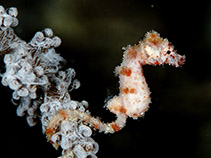 Hippocampus waleananus
Photo von Ryanskiy, A.
Bilder | Google Bild
Photo von Ryanskiy, A.
Klassifizierung / Names Namen | Synonyme | Catalog of Fishes(Gattung, Arten) | ITIS | CoL | WoRMS | Cloffa
> Syngnathiformes (Pipefishes and seahorses) > Syngnathidae (Pipefishes and seahorses) > Syngnathinae
Etymology: Hippocampus: Greek, ippos = horse + Greek,kampe = curvature (Ref. 45335); waleananus: Named for its type and only confirmed locality Walea Island, Sulawesi, Indonesia, where this species occurs and the Latin nanus for "dwarf".
Etymology: Hippocampus: Greek, ippos = horse + Greek,kampe = curvature (Ref. 45335); waleananus: Named for its type and only confirmed locality Walea Island, Sulawesi, Indonesia, where this species occurs and the Latin nanus for "dwarf".
Taxonomic Remarks
Junior synonym in Lourie et al., 2016; valid in ECoff., 2023.
Umwelt: Milieu / Klimazone / Tiefenbereich / Verbreitungsgebiet Ökologie
seewasser benthopelagisch; standorttreu; tiefenbereich 5 - 20 m (Ref. 80667). Tropical
Verbreitung Territorien | FAO Gebiete | Ökosysteme | Vorkommen | Punkt Karte | Einführungen | Faunafri
Western Central Pacific: Indonesia.
Größe / Gewicht / Alter
Kurzbeschreibung Bestimmungsschlüssel | Morphologie | Morphometrie
Rückenflossenweichstrahlen (insgesamt) : 12. This species is distinguished by the following characters: size extremely small (height 1.68 cm, 1.78 cm SL); trunks rings 12; tail elongate, 32 tail rings; D 12; pectoral fin rays 9; no anal fin (at least in one sex); apparently eggs brooded within trunk; medium length snout which lacks a bulbous tip; coronet raised and angular; fused gill openings on midline behind the coronet supported by raised cleithral girdle; enlarged knob-like structures on head and trunk; paired laterally directed knob-like structures and each with short fleshy filament on superior trunk ridge of the fifth trunk ring; last 28 tail rings each with small paired knobs on inferior tail ridge, fifth, ninth and twelfth tail rings with bilaterally paired enlarged knob-like structures on superior tail ridges. Colouration: pale pinkish to yellowish with red to brown blotches, radiating bands from eye; body protuberances are white, appearing as white spots (Ref. 80667).
Body shape (shape guide): other; Cross section: angular.
Body shape (shape guide): other; Cross section: angular.
Found in association with the soft coral Nephtea, but has also been observed swimming lengthy distances from one coral to the next (Ref 90102).
Lebenszyklus und Paarungsverhalten Geschlechtsreife | Fortpflanzung | Ablaichen | Eier | Fruchtbarkeit | Larven
Male carries the eggs in a brood pouch (Ref. 205).
Hauptreferenz
Laden Sie Ihre Referenzen hoch | Referenzen | Koordinator | Partner
Short, G., R. Smith, H. Motomura, D. Harasti and H. Hamilton, 2018. Hippocampus japapigu, a new species of pygmy seahorse from Japan, with a redescription of H. pontohi (Teleostei, Syngnathidae). ZooKeys 779:27-49. (Ref. 118476)
IUCN Rote Liste Status (Ref. 130435: Version 2025-2 (Global))
vom Aussterben bedroht (CR) (A2b+3b); Date assessed: 13 December 2023
Bedrohung für Menschen
Harmless
Nutzung durch Menschen
FAO - Publication: search | FishSource |
Mehr Information
Trophische Ökologie
Lebensmittel (Beutetiere)
Nahrungszusammensetzung
Nahrungsaufnahme
Lebensmittelrationen
Räuber
Lebensmittel (Beutetiere)
Nahrungszusammensetzung
Nahrungsaufnahme
Lebensmittelrationen
Räuber
Populationsdynamik
Wachstumsparameter
Max. Alter/Größen
Länge-Gewicht-Rel.
Länge-Länge-Verhältnis.
Längenhäufigkeiten
Massenkonvertierung
Rekrutierung
Dichte
Wachstumsparameter
Max. Alter/Größen
Länge-Gewicht-Rel.
Länge-Länge-Verhältnis.
Längenhäufigkeiten
Massenkonvertierung
Rekrutierung
Dichte
Lebenszyklus
Fortpflanzung
Geschlechtsreife
Reifung/Kiemen rel.
Fruchtbarkeit
Ablaichen
Laichaggregationen
Eier
Eientwicklung
Larven
Larven Pop.Dyn.
Fortpflanzung
Geschlechtsreife
Reifung/Kiemen rel.
Fruchtbarkeit
Ablaichen
Laichaggregationen
Eier
Eientwicklung
Larven
Larven Pop.Dyn.
Anatomie
Kiemenoberfläche
Gehirn
Otolith
Kiemenoberfläche
Gehirn
Otolith
Physiologie
Körperliche Zusammensetzung
Nährstoffe
Sauerstoffverbrauch
Schwimmart
Schwimmgeschwindigkeit
Visuelle Pigmente
Fischgeräusche
Krankheiten und Parasiten
Toxizität (LC50s)
Körperliche Zusammensetzung
Nährstoffe
Sauerstoffverbrauch
Schwimmart
Schwimmgeschwindigkeit
Visuelle Pigmente
Fischgeräusche
Krankheiten und Parasiten
Toxizität (LC50s)
Genetik
Genom
Genetik
Heterozygotie
Vererbbarkeit
Genetische Vielfalt
Genom
Genetik
Heterozygotie
Vererbbarkeit
Genetische Vielfalt
Menschenbezogen
Aquakultur-Systeme
Aquakultur Profile
Zuchtlinien
Ciguatera-Fälle
Briefmarken, Münzen, Verschiedenes.
Aquakultur-Systeme
Aquakultur Profile
Zuchtlinien
Ciguatera-Fälle
Briefmarken, Münzen, Verschiedenes.
Tools
Zusatzinformationen
Download XML
Zusammenfassung | Punktdaten | Namen | Photos
Internet Quellen
AFORO (otoliths) | Aquatic Commons | BHL | Cloffa | Websites from users | FishWatcher Einträge suchen | CISTI | Catalog of Fishes: Gattung, Arten | DiscoverLife | ECOTOX | FAO - Publication: search | Faunafri | Fishipedia | Fishtrace | GloBI | Google Books | Google Scholar | Google | IGFA World Record | OneZoom | Open Tree of Life | Otolith Atlas of Taiwan Fishes | PubMed | Reef Life Survey | Socotra Atlas | TreeBase | Tree of Life | Wikipedia: Gehe zu, Suchen | World Records Freshwater Fishing | Zoobank | Zoologischer Rekord
Schätzungen auf der Grundlage von Modellen
Phylogenetischer Diversitätsindex (Ref. 82804): PD50 = 0.5000 [Uniqueness, from 0.5 = low to 2.0 = high].
Bayesian length-weight: a=0.00447 (0.00176 - 0.01132), b=3.00 (2.78 - 3.22), in cm total length, based on LWR estimates for this (Sub)family-body shape (Ref. 93245).
Trophische Ebene (Ref. 69278): 3.0 ±0.3 se; based on size and trophs of closest relatives
Widerstandsfähigkeit (Ref. 120179): hoch, Verdopplung der Population dauert weniger als 15 Monate. (Preliminary K or Fecundity.).