This website uses cookies to enhance your browsing experience and ensure the functionality of our site. For more detailed information about the types of cookies we use and how we protect your privacy, please visit our Privacy Information page.
×
Cookie Settings
This website uses different types of cookies to enhance your experience. Please select your preferences below:
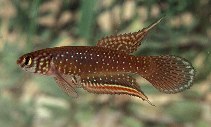
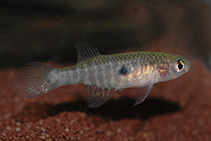
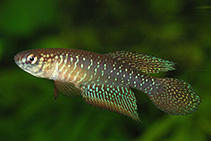
Nematolebias whitei, Rio pearlfish : fisheries, aquarium
> Cyprinodontiformes (Rivulines, killifishes and live bearers) > Rivulidae (Rivulines) > Cynolebiinae
Etymology: Nematolebias:Greek, nema, -atos = filament + Greek, lebias, ou = a kind of small fish (Ref. 45335). Eponymy: General Thomas Dresser White (1901–1965) was the Chief of Staff, United States Air Force, in which he served (1924–1961), having initially been an infantry officer (1920–1924). [...] (Ref. 128868), visit book page. More on author: Myers.
Umwelt: Milieu / Klimazone / Tiefenbereich / Verbreitungsgebiet Ökologie
Rückenflossenstacheln (insgesamt) : 0; Rückenflossenweichstrahlen (insgesamt) : 13 - 19; Afterflossenstacheln: 0; Afterflossenweichstrahlen: 18 - 24; Wirbelzahl: 29 - 31. Having series of small bluish white spots, often coalesced to form continuous or fragmented line, on subdistal area of caudal fin and dark brown to black stripe on border of anal fin, adjacent and parallel to perpendicular extensions of subdistal golden transverse lines. Dorsal head profile slightly convex to nearly straight in male, gently concave to approximately straight in female (Ref. 42934). Body shape (shape guide): fusiform / normal.
Adults occur in small freshwater temporary pools in floodplains of streams and lagoons. These pools are shallow with compact, soft reddish brown muddy bottom and dry twice a year, during winter, usually from July to August, and during summer, usually from February to March. During dry season, all fish die and eggs undergo in diapause within the substrate. Eclosion happens at the onset of wet season, usually March-April and September-October (Ref. 42934). This species was introduced in California (Ref. 4357). Bottom spawner, 4 months incubation. Is easy to maintain in the aquarium (Ref. 27139).
Males are territorial and very aggressive. Males display an elaborate courtship behavior beginning with waving lateral movement in front of female, with the unpaired fins completely opened. In an oblique position, the male touches the bottom surface with the anterior portion of its head, with vibrating body. The female placed her body side to side with the male. Then both couple dives into the substrates where spawning takes place (Ref. 42934).
Costa, W.J.E.M., 2002. The neotropical seasonal fish genus Nematolebias (Cyprinodontiformes: Rivulidae: Cynolebiatinae): taxonomic revision with description of a new species. Ichthyol. Explor. Freshwat. 13(1):41-52. (Ref. 42934)
IUCN Rote Liste Status (Ref. 130435: Version 2025-2 (Global))
stark gefährdet (EN) (B1ab(i,ii,iii,iv,v)+2ab(i,ii,iii,iv,v)); Date assessed: 18 May 2022
Phylogenetischer Diversitätsindex (Ref. 82804): PD50 = 0.6250 [Uniqueness, from 0.5 = low to 2.0 = high].
Bayesian length-weight: a=0.01122 (0.00514 - 0.02450), b=3.04 (2.87 - 3.21), in cm total length, based on all LWR estimates for this body shape (Ref. 93245).
Trophische Ebene (Ref. 69278): 3.3 ±0.4 se; based on size and trophs of closest relatives
Widerstandsfähigkeit (Ref. 120179): hoch, Verdopplung der Population dauert weniger als 15 Monate. (tm=0.1).
Anfälligkeit der Fischerei (Ref. 59153): Low vulnerability (10 of 100). 🛈