This website uses cookies to enhance your browsing experience and ensure the functionality of our site. For more detailed information about the types of cookies we use and how we protect your privacy, please visit our Privacy Information page.
×
Cookie Settings
This website uses different types of cookies to enhance your experience. Please select your preferences below:
Western Atlantic: Bermuda and southern Florida, USA to Brazil. Lesser Antilles (Ref. 26938). Eastern Atlantic: Senegal to Angola (Ref. 4455). Doubtful record from the western Mediterranean (Ref. 13729).
Größe / Gewicht / Alter
Geschlechtsreife: Lm? range ? - ? cm Max length : 210 cm TL Männchen/unbestimmt; (Ref. 26938); common length : 100.0 cm TL Männchen/unbestimmt; (Ref. 5217)
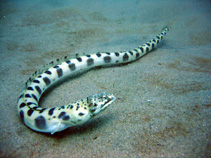
Body pale, dark band across back of head (Ref. 26938). Body shape (shape guide): eel-like.
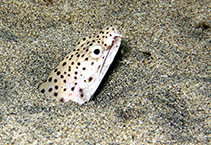
Maximum depth from Ref. 126840. Lives in a permanent burrow, often in very shallow water. Heads protrude diagonally from the sand. Nocturnal. Feeds on octopus and fish (Ref. 5217). Bold and easily approached. Feared by fishers (Ref. 9710). Rarely consumed (Ref. 3795).
Böhlke, J.E., 1981. Ophichthidae. In W. Fischer, G. Bianchi and W.B. Scott (eds.) FAO species identification sheets for fishery purposes. Eastern Central Atlantic, (Fishing Areas 34, 47 (in part)), Vol. 3, [var. pag.]. FAO, Rome. (Ref. 3651)
IUCN Rote Liste Status (Ref. 130435: Version 2025-2 (Global))
Bevorzugte Temperatur (Ref. 123201): 19.2 - 27.5, mean 24.8 °C (based on 156 cells).
Phylogenetischer Diversitätsindex (Ref. 82804): PD50 = 0.5000 [Uniqueness, from 0.5 = low to 2.0 = high].
Bayesian length-weight: a=0.00093 (0.00041 - 0.00214), b=2.99 (2.79 - 3.19), in cm total length, based on LWR estimates for this (Sub)family-body shape (Ref. 93245).
Trophische Ebene (Ref. 69278): 4.5 ±0.80 se; based on food items.
Widerstandsfähigkeit (Ref. 120179): sehr niedrig, Verdopplung der Population dauert mehr als 14 Jahre. (Preliminary K or Fecundity.).
Anfälligkeit der Fischerei (Ref. 59153): Very high vulnerability (90 of 100). 🛈