



Adicionar as suas observações no Fish Watcher
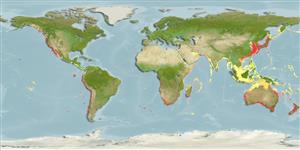
| Native range | All suitable habitat | Point map | Year 2050 |
|
| This map was computer-generated and has not yet been reviewed. |
| Sardinops sagax AquaMaps Data sources: GBIF OBIS |
Adicionar o seu Fotografias e vídeos
Fotografias | vídeos | Selos, moedas, diversos. | Imagem do Google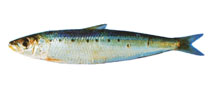 Sardinops sagax
Fotografia de SeaFIC
Fotografias | vídeos | Selos, moedas, diversos. | Imagem do Google
Fotografia de SeaFIC
Classificação / Nomes Nomes comuns | Sinónimos | Catalog of Fishes(Género, Espécies) | ITIS | CoL | WoRMS | Cloffa
> Clupeiformes (Herrings) > Alosidae (Shads and Sardines)
Etymology: Sardinops: Latin and Greek, sarda = sardine; name related to the island of Sardinia + Greek, ops = appearance (Ref. 45335); sagax: From the latin word 'sagax' which means of quick perception, acute, or alert (Ref. 6885).
More on author: Jenyns.
Etymology: Sardinops: Latin and Greek, sarda = sardine; name related to the island of Sardinia + Greek, ops = appearance (Ref. 45335); sagax: From the latin word 'sagax' which means of quick perception, acute, or alert (Ref. 6885).
More on author: Jenyns.
Ambiente: milieu / zona climática / intervalo de profundidade / gama de distribuição Ecologia
marinhas pelagic-neritic; oceanódromo (Ref. 138310); intervalo de profundidade 0 - 200 m (Ref. 188). Subtropical; 9°C - 21°C (Ref. 6390); 61°N - 47°S, 145°W - 180°E (Ref. 36641)
Distribuição Territórios | Áreas FAO | Ecossistemas | Ocorrências | Mapa dos pontos | Introduções | Faunafri
Indo-Pacific: southern Africa to eastern Pacific (Ref. 27267). Three lineages were confirmed through cluster and parsimony analyses of haplotypic divergences: southern Africa (ocellatus) and Australia (neopilchardus); Chile (sagax) and California (caeruleus); and, Japan (melanostictus) (Ref. 36641).
Comprimento na primeira maturidade / Tamanho / Peso / Idade
Maturidade: Lm 9.0 range ? - ? cm
Max length : 39.5 cm SL macho/indeterminado; (Ref. 9291); common length : 20.0 cm SL macho/indeterminado; (Ref. 188); peso máx. Publicado: 486.00 g (Ref. 6885); Idade máx. registada: 25 anos (Ref. 188)
Max length : 39.5 cm SL macho/indeterminado; (Ref. 9291); common length : 20.0 cm SL macho/indeterminado; (Ref. 188); peso máx. Publicado: 486.00 g (Ref. 6885); Idade máx. registada: 25 anos (Ref. 188)
Descrição breve Chaves de identificação | Morfologia | Morfometria
Espinhos dorsais (total) : 0; Raios dorsais moles (total) : 13 - 21; Espinhos anais: 0; Raios anais moles: 12 - 23; Vértebras: 48 - 54. Body cylindrical and elongate; ventral part of operculum with clear cut bony striae radiating downwards; belly rounded with ventral scutes; back blue green; flanks white, with 1 to 3 series of dark spots along the middle (Ref. 55763). The radiating bony striae on the operculum distinguish this species from all other clupeids in the area. The radiating bony striae on the operculum distinguish this fish from all other clupeids in the area. In New Zealand the species appears to grow larger (21.3 cm standard length; cf. 19.7 cm), has slightly larger eggs and a higher mean number of vertebrae (50.52; cf. 49 to 50.08 in various samples) (Ref. 859).
Body shape (shape guide): fusiform / normal; Cross section: compressed.
Body shape (shape guide): fusiform / normal; Cross section: compressed.
Neritic (Ref. 11230). A coastal species that forms large schools (Ref. 188). Adults occur at temperatures ranging from 16° to 23°C in summer and from 10° to 18°C in winter. They feed mainly on planktonic crustaceans. Young fish feed on zooplankton such as copepod and adults on phytoplankton (Ref. 39882). Oviparous, with pelagic eggs, and pelagic larvae (Ref. 265). Possibly can live up to 25 years (Ref. 265). In the California region, pilchards make northward migrations early in summer and travel back south again in autumn. With each year of life, the migration becomes farther (Ref. 6885). Marketed fresh, frozen or canned. Utilized mainly for fish meal; but also eaten fried and broiled (Ref. 9988). Main source of landing: NE Pacific: Mexico (Ref. 4931).
Ciclo de vida e comportamento de acasalamento Maturidade | Reprodução | Desova | Ovos | Fecundidade | Larvas
Oviparous (Ref. 265). In the Gulf of California, some individuals spawn in their first year, but most in their second (Ref. 188).
In Australia (as S. neopilchardus), this species breeds in spring and summer in southern part of range, and in summer and autumn in northern part, apparently related to seasonal movement of the limiting 14°C and 21°C isotherms, then autumn to early spring (Ref. 6390). It was believed that individual Australian pilchards only spawn once or twice in a season (Ref. 26422, 26424), but research on related species suggests that they may spawn a number of times (Ref. 6882). Batch fecundities range from about 10,000 eggs in 13 cm long females to about 45,000 eggs in females of about 18 cm (Ref. 26420).
Referência principal
Carregar as suas referências | Referências | Coordenador | Colaboradores
Whitehead, P.J.P., 1985. FAO Species Catalogue. Vol. 7. Clupeoid fishes of the world (suborder Clupeoidei). An annotated and illustrated catalogue of the herrings, sardines, pilchards, sprats, shads, anchovies and wolf-herrings. FAO Fish. Synop. 125(7/1):1-303. Rome: FAO. (Ref. 188)
Categoria na Lista Vermelha da IUCN (Ref. 130435: Version 2025-2 (Global))
Preocupação menor (LC) ; Date assessed: 18 July 2018
CITES
Not Evaluated
Ameaça para o homem
Harmless
Utilização humana
Pescarias: altamente comercial; isco: usually
FAO - pescarias: desembarques, perfil da espécie; Publication: search | FishSource | Sea Around Us
Mais informação
Ecologia Trófica
Produtos alimentares (presas)
Composição da dieta
Consumo alimentar
Rações alimentares
Predadores
Produtos alimentares (presas)
Composição da dieta
Consumo alimentar
Rações alimentares
Predadores
Dinâmica das populações
Parâmetros de crescimento
Idades / tamanhos máximos
Comprimento-peso rel.
Comprimento-comprimento rel.
Frequência de comprimento
Conversão de massa
Recrutamento
Abundância
Parâmetros de crescimento
Idades / tamanhos máximos
Comprimento-peso rel.
Comprimento-comprimento rel.
Frequência de comprimento
Conversão de massa
Recrutamento
Abundância
Ciclo de vida
Reprodução
Maturidade
Maturidade/Rel. das guelras
Fecundidade
Desova
Agregações de desova
Ovos
Desenvolvimento dos ovos
Larvas
Dinâmica larvar
Reprodução
Maturidade
Maturidade/Rel. das guelras
Fecundidade
Desova
Agregações de desova
Ovos
Desenvolvimento dos ovos
Larvas
Dinâmica larvar
Fisiologia
Composição corporal
Nutrientes
Consumo de oxigénio
Tipo de natação
Velocidade de natação
Pigmentos visuais
Som de peixe
Doenças e Parasitas
Toxicidade (LC50s)
Composição corporal
Nutrientes
Consumo de oxigénio
Tipo de natação
Velocidade de natação
Pigmentos visuais
Som de peixe
Doenças e Parasitas
Toxicidade (LC50s)
Relacionado com o ser humano
Sistemas de aquacultura
Perfis para aquacultura
Estirpes
Casos de Ciguatera
Selos, moedas, diversos.
Sistemas de aquacultura
Perfis para aquacultura
Estirpes
Casos de Ciguatera
Selos, moedas, diversos.
Ferramentas
E-book | Guia de campo | Chaves de identificação | Ferramenta auxiliar de frequências de comprimento | Ferramenta sobre a história de vida | Mapa dos pontos |
Captura-MSY |
Relatórios especiais
Descarregue XML
Fontes da internet
AFORO (otoliths) | Aquatic Commons | BHL | Cloffa | Websites from users | Consultar FishWatcher | CISTI | Catalog of Fishes: Género, Espécies | DiscoverLife | ECOTOX | FAO - pescarias: desembarques, perfil da espécie; Publication: search | Faunafri | Fishipedia | Fishtrace | GloBI | Google Books | Google Scholar | Google | IGFA World Record | Bases de dados nacionais | OceanAdapt | OneZoom | Open Tree of Life | OsteoBase: skull, spine | Otolith Atlas of Taiwan Fishes | Aquários públicos | PubMed | Reef Life Survey | Socotra Atlas | TreeBase | Árvore da vida | Wikipedia: ir para, procurar | World Records Freshwater Fishing | Registo zoológico
Estimativas baseadas em modelos
Temperatura preferida (Ref. 123201): 9.5 - 25.2, mean 17.9 °C (based on 938 cells).
Índice de diversidade filogenética (Ref. 82804): PD50 = 1.0000 [Uniqueness, from 0.5 = low to 2.0 = high].
Bayesian length-weight: a=0.00776 (0.00640 - 0.00942), b=3.10 (3.05 - 3.15), in cm total length, based on LWR estimates for this species (Ref. 93245).
Nível Trófico (Ref. 69278): 2.8 ±0.1 se; based on diet studies.
Generation time: 2.6 (2.2 - 2.8) years. Estimated as median ln(3)/K based on 58 growth studies.
Resiliência (Ref. 120179): Médio, tempo mínimo de duplicação da população 1,4 - 4,4 anos (K=0.45; tm=2; tmax=13-25; Fec=10,000).
Prior r = 0.54, 95% CL = 0.36 - 0.81, Based on 6 full stock assessments.
Nutrientes (Ref. 124155): Calcium = 185 [49, 457] mg/100g; Iron = 2.12 [0.69, 5.66] mg/100g; Protein = 20.5 [17.9, 22.6] %; Omega3 = 0.762 [0.385, 1.536] g/100g; Selenium = 43.3 [13.0, 137.7] μg/100g; VitaminA = 14.8 [2.9, 62.4] μg/100g; Zinc = 1.85 [0.57, 3.60] mg/100g (wet weight); based on nutrient studies.